
The 20th Annual Holiday Shopping Survey of 16,138 consumers shows more intentional spending, earlier shopping, and growing use of AI agents
Shoppers are feeling the squeeze this holiday season, but they do not plan to pull back on spending, according to Accenture’s 20th Annual Holiday Shopping Survey. Instead, they are becoming more intentional: actively seeking promotions, comparing options, and increasingly using AI to find value and stretch their budgets.
A RECALIBRATED SEASON
For many consumers, the holiday season is already underway. The survey of 16,138 consumers finds that, despite continued financial pressure, shoppers are not abandoning the season. They are recalibrating. Budgets are rising largely because prices have increased, which is pushing consumers to be more deliberate about where, when, and how they spend.
AI has also become a meaningful shopping companion. Accenture’s survey suggests 2026 could be the first holiday season in which consumers use these tools at scale. Shoppers expect generative AI (GenAI) to influence 45 percent of category spend, and nearly 30 percent would trust a personal AI agent more than themselves for holiday shopping.
Most consumers are not ready to give these tools full control. That gives retailers a chance to build trust through reliable guidance while keeping the experience, confidence, and human connection at the heart of holiday shopping.
SPENDING HOLDS UP, BUT PRICES DRIVE BUDGETS
Higher budgets reflect rising prices more than a willingness to splurge.
- 30 percent of consumers expect a higher holiday budget this year. Among shoppers expecting to spend the same or more, 56 percent say it is because “the cost of everything has gone up.”
- Holiday budgets are expected to rise by an average of about 9 percent year over year across geographies including the US, UK, and Australia.
- Spending stays concentrated in traditional categories: clothing and accessories (51 percent), food and beverage treats (50 percent), and gift cards or vouchers (41 percent).
- Financial pressure is shaping where people shop. Four in ten plan to buy from online and e-commerce retailers or supermarkets and grocery stores, and a third plan to buy gifts at mass merchants and warehouse clubs.
THE SEASON STARTS EARLIER
The holiday season is no longer defined by a few peak days. Consumers start earlier and spread their spending across the season.
- 8 in 10 shoppers plan to begin before Black Friday and Cyber Monday.
- Nearly 14 percent of consumers began holiday shopping before August this year, about double the share in 2025 (6 percent).
AI BECOMES A SHOPPING GO-TO
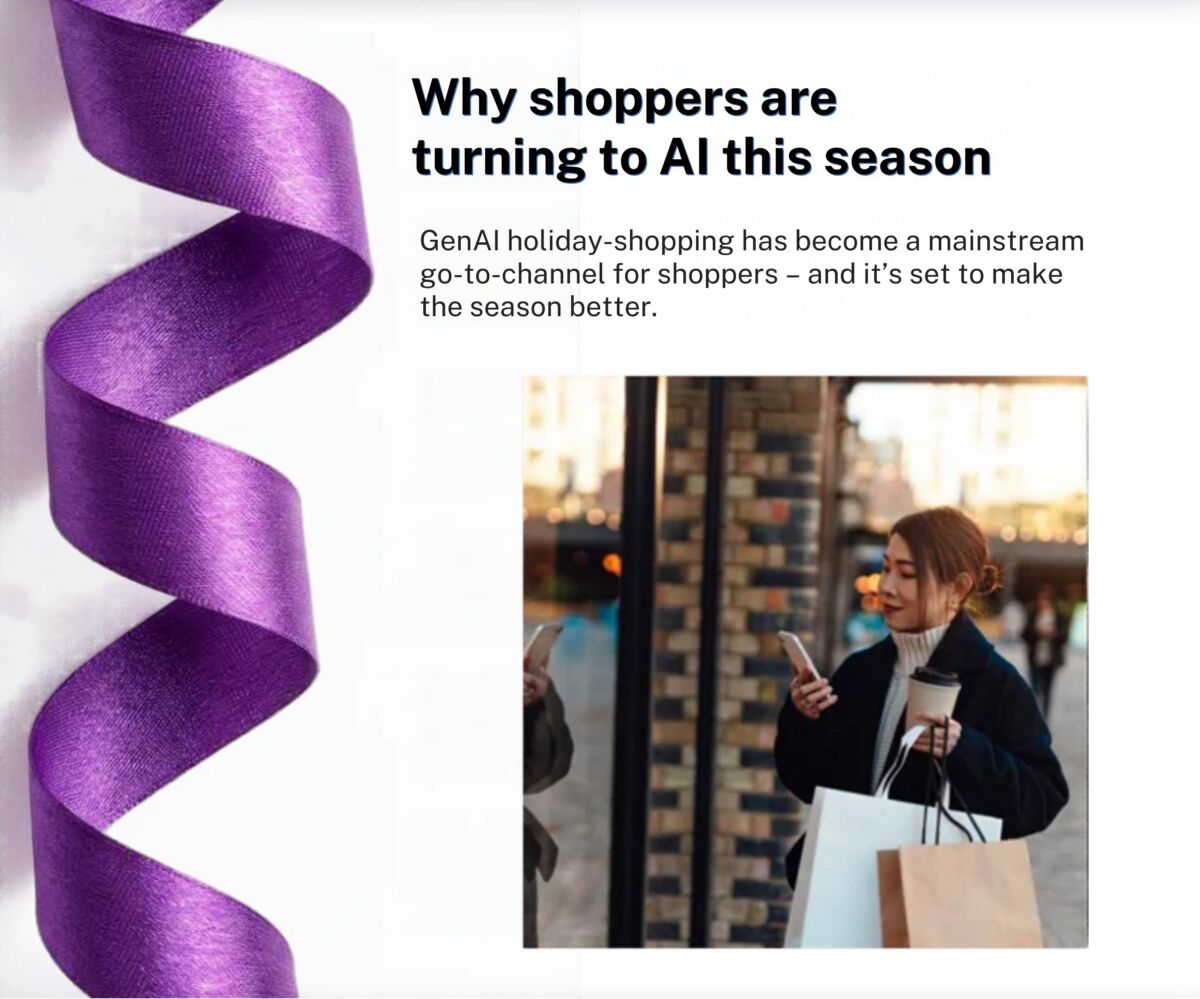
GenAI has become a mainstream channel for holiday shopping.
- Shoppers expect GenAI to influence an average 45 percent of category spend.
- Three in ten shoppers trust an AI agent more than themselves with holiday shopping.
- Consumers are open to AI for their most personal purchases. One in three think an AI agent does a better job than they do at buying gifts for loved ones.
- 36 percent are open to using AI agents to buy for friends, 32 percent for themselves, and 32 percent for a spouse.
- Deal-finding leads planned AI use cases at 40 percent, followed by discovering products, comparing options, and deciding where to buy, at 31 percent each.
- 76 percent are open to collaborating with an agent and 61 percent to agent-executed tasks. 24 percent would let it decide what to buy, and 8 percent would let it purchase independently. These are shopper views even before the technology to do so is fully available.
- Nearly 3 in 10 shoppers lean toward retailer- or brand-specific tools over cross-brand technology agents, which suggests embedded shopping context matters. Among those favoring retailer agents, 26 percent cite confidence that their personal and payment data will stay secure, and 33 percent believe the retailer is most likely to get them the best prices and deals.
STORES STILL MATTER
Shoppers continue to rely on stores for inspiration, nostalgia, advice, and confidence.
- Stores and digital channels continue to have an equal share of holiday shopping. Even active GenAI users, who skew more digital, still expect stores to play a meaningful role.
- Nearly three-quarters of consumers want agents to buy only from preferred or familiar brands and retailers this holiday, even when alternatives fit.
- 43 percent are turning to stores to see, touch, or try products before buying.
- Stores are a popular source of recommendations and advice for 1 in 2 shoppers. GenAI ranks lower, as a popular source for 4 in 10.
WHAT THE EXECUTIVES SAY
“Consumers may be cautious, but they still plan to spend. Our latest Holiday Shopping Survey finds that globally, 30% of consumers expect a higher holiday budget this year. Yet much of that increase reflects higher prices, not a willingness to splurge. Consumers are becoming increasingly deliberate about how they spend, rethinking what’s important and increasingly looking for ways to make their budget go as far as possible,” said Accenture global consumer goods, retail, and travel lead Kath Gramling.
Gramling added: “Value is no longer defined by price alone. Consumers are also weighing the experience, the memories and the personal meaning attached to every purchase. The retailers that help shoppers balance price with confidence will be best positioned to make every gift feel worthwhile.”
“The holiday season has always been about more than transactions. It’s one of the most emotional and intentional spending moments of the year, shaped by traditions, celebrations and the desire to create meaningful experiences for family and friends. This year, consumers are turning to AI shopping tools at scale to help them navigate more choices, find better value and make smarter decisions,” said Accenture global retail lead Kelly Askew.
Askew added: “But AI’s recommendations are only as good as the information it can access. For retailers, the opportunity is to ensure these tools can access the information consumers need to make informed decisions: product details, pricing, reviews, return policies, while creating a seamless path to purchase through an agent, online or in store. Success will come down to understanding customer intent and delivering the right information, convenience, and support at every stage of the journey.”
ABOUT THE SURVEY
The 20th Annual Holiday Shopping Survey involved 16,138 consumers and was conducted between August 13 and September 1, 2026. It examines consumer behaviors and buying patterns during the holiday season as an indicator of retail performance expectations online and in stores. Respondents were split by gender and across age groups: 15 percent Gen Z (ages 18 to 29), 30 percent millennials (30 to 45), 29 percent Gen X (46 to 61), and 26 percent baby boomers (62 to 80).