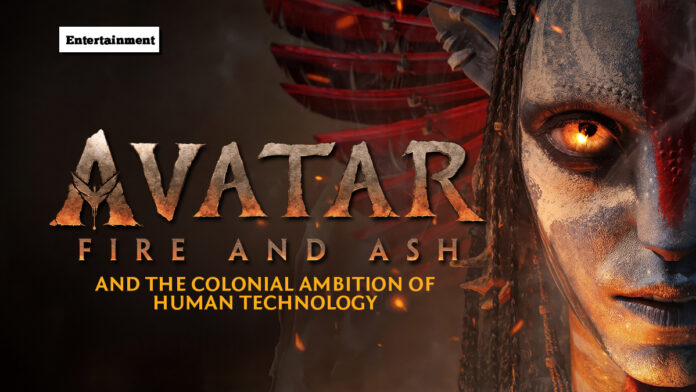

Spoiler alert: The following discussion contains key plot points and character developments from Avatar: Fire and Ash.
What once felt like pure fantasy in 2009’s Avatar no longer seems entirely implausible. The pace of technological innovation over the past few years has been staggering. Artificial intelligence can now predict trends and model human behavior. Biotechnology is advancing toward gene editing and synthetic life. Robotics increasingly blurs the line between human and machine.
If the original Avatar felt like a distant dream, Fire and Ash arrives in a world where the science it once imagined is rapidly becoming reality. That shift makes the film’s warnings about human ambition, exploitation, and technological dominance feel more urgent and uncomfortably familiar.
1. Technology as the New Colonial Weapon
The Resources Development Administration arrives on Pandora armed with machines that make domination appear effortless. Ships, drones, and hybrid avatars are not merely cinematic spectacle. They function as metaphors for how technology amplifies power.
This is no longer confined to fiction. Modern corporations deploy AI systems, satellite surveillance, and drones to extract resources in remote regions of the world. The parallels are difficult to ignore. Colonial logic has not disappeared. It has simply been upgraded.
Technology now enables corporations to override indigenous rights and access environments that were once protected by geography or community resistance. In Fire and Ash, the machinery of conquest is visible and loud. In reality, it is often quieter, embedded in data, automation, and remote control.

2. Biotechnology as a Tool of Domination
Spider, the human boy raised on Pandora, becomes a living symbol of what happens when colonial ambition intersects with biotechnology. His ability to breathe Pandora’s air makes him valuable not as a person, but as a resource. Something to be studied, replicated, and potentially weaponized.
That framing is chilling because it mirrors real-world scientific mindsets. If life can be altered, enhanced, or optimized, why not exploit it for advantage?
Technologies like CRISPR and synthetic biology already allow humans to modify organisms for medicine, agriculture, and performance enhancement. Without firm ethical boundaries, these tools can easily shift from healing to control. The film does not exaggerate this risk. It simply pushes it into sharper focus.

3. Hybridization and the Illusion of Absolute Power
Colonel Quaritch’s return in a Na’vi-human hybrid body is one of the film’s most unsettling statements. Stronger, faster, and deadlier, he embodies the idea that technology can erase limits and resistance.
This logic is not new. Military and corporate institutions already integrate robotics, automation, and AI to enhance efficiency and dominance. The more advanced the tools become, the less human cost seems to matter.
Watching Quaritch move through Pandora, it is difficult not to recognize a familiar pattern. We already build systems that amplify inequality and control. The film simply dramatizes what happens when those systems are given physical form.

4. Ecosystem Resistance Versus Technological Conquest
Pandora does not remain passive. Through Kiri’s connection to Eywa, the ecosystem itself responds, mobilizing against human intrusion. This resistance serves as a reminder that no amount of technological sophistication guarantees uncontested domination.
Around the world, indigenous communities already combine traditional knowledge with modern monitoring tools to defend their land and ecosystems from powerful extractive industries. The struggle is not between nature and technology, but between stewardship and exploitation.
Fire and Ash suggests that resistance is inevitable, not because technology fails, but because domination always provokes response.
5. The Exploitation of Sentient Life
The hunting of Tulkun whales during mating season is one of the film’s most disturbing moments. It is not simply shocking for spectacle’s sake. It is a clear indictment of profit-driven ethics.
Colonialism has never been solely about land. It is about turning life into a commodity, using technology to maximize yield while ignoring consequence. Deep-sea mining, industrial fishing, and large-scale poaching follow the same logic seen on Pandora. Different setting, same mindset.
Technology makes extraction more efficient, but it does not make it moral.

Conclusion
Avatar: Fire and Ash is more than entertainment. It is a warning.
Technology and biotechnology may be neutral tools, but in human hands, they are often shaped by ambition, power, and historical patterns of domination. Spider’s transformation, Quaritch’s hybrid body, and the systematic exploitation of Pandora’s ecosystem all point to the same truth. Colonial ambition adapts. It evolves. And now, it is fueled by our own innovations.
If these realities go unexamined, the future of technology risks repeating the mistakes of the past, only faster, smarter, and far more difficult to resist.
Words by Aljhelyn Piador
Also published in GADGETS MAGAZINE Volume 26 Issue No. 6