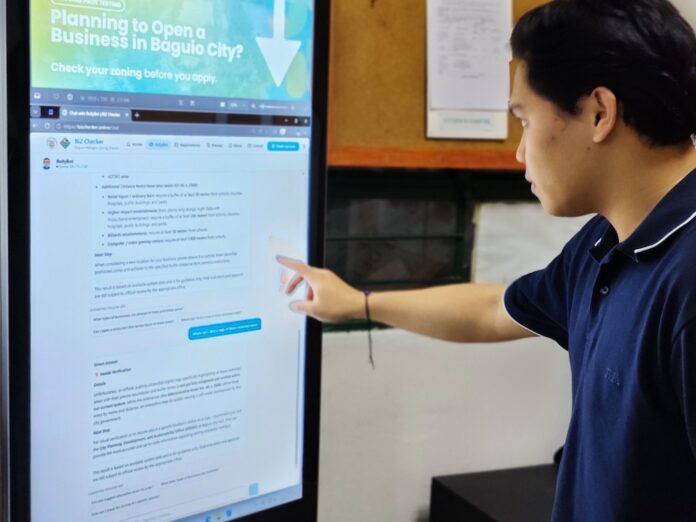

Baguio City is testing how AI can help businesses determine whether their proposed ventures comply with local zoning rules, as the city refines a digital tool developed with support from PLDT and Smart’s AI-in-a-Box program.
AI-in-a-Box is the PLDT Group’s initiative to make artificial intelligence more accessible to communities, combining digital tools, connectivity, and training to help organizations and local governments turn emerging technologies into practical solutions.
THE AI-IN-A-BOX SUPPORT
Earlier this year, PLDT and Smart, with support from PLDT Smart Foundation, Lenovo Philippines, and Microsoft, provided the Baguio City government with an AI access kit, which includes a laptop, a smartphone, a connectivity device, and premium access to AI tools.
“Technology for good means using innovation to address real needs in our communities,” said Stephanie V. Orlino, AVP and head of stakeholder engagement at PLDT and Smart. “Through AI-in-a-Box, PLDT and Smart are working with local government units not only to provide access to AI, but also to build their capacity to develop practical solutions. We hope these efforts can help local government units (LGUs) make public services more responsive and meaningful for the people they serve.”
Select LGU staff from Baguio City underwent a three-month AI mentorship and acceleration program under PLDT and Smart’s AI-in-a-Box to enable them to create an AI-powered solution that can help improve public service delivery.
HOW BIZ CHECKER WORKS
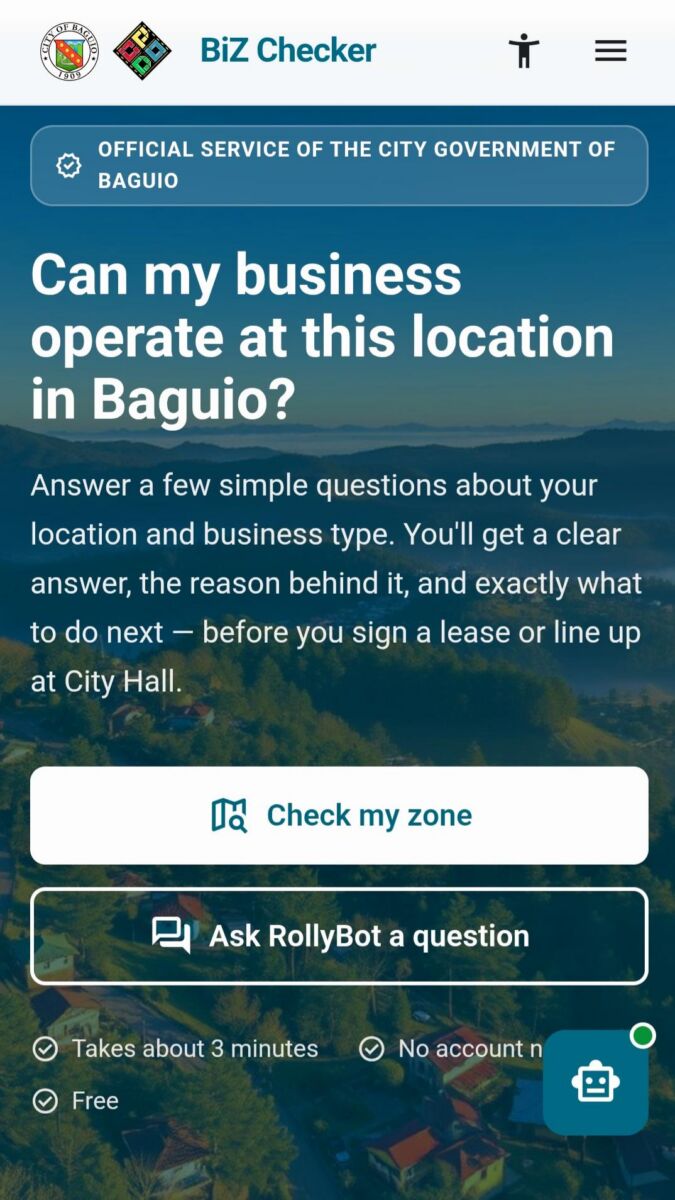
The program has led to ‘BIZ Checker’, an online tool that helps applicants determine whether a proposed establishment is allowed in a particular location based on the city’s zoning classifications and requirements.
“Using the platform, the client or the applicant can see if their business is appropriate for that site,” said Roland Bautista, senior project evaluation officer of the Baguio City Planning, Development and Sustainability Office.
The tool is designed to address a common pain point in the permitting process: applicants sometimes discover only after approaching the city that their documents are incomplete or that their proposed establishment is not permitted in their chosen location.
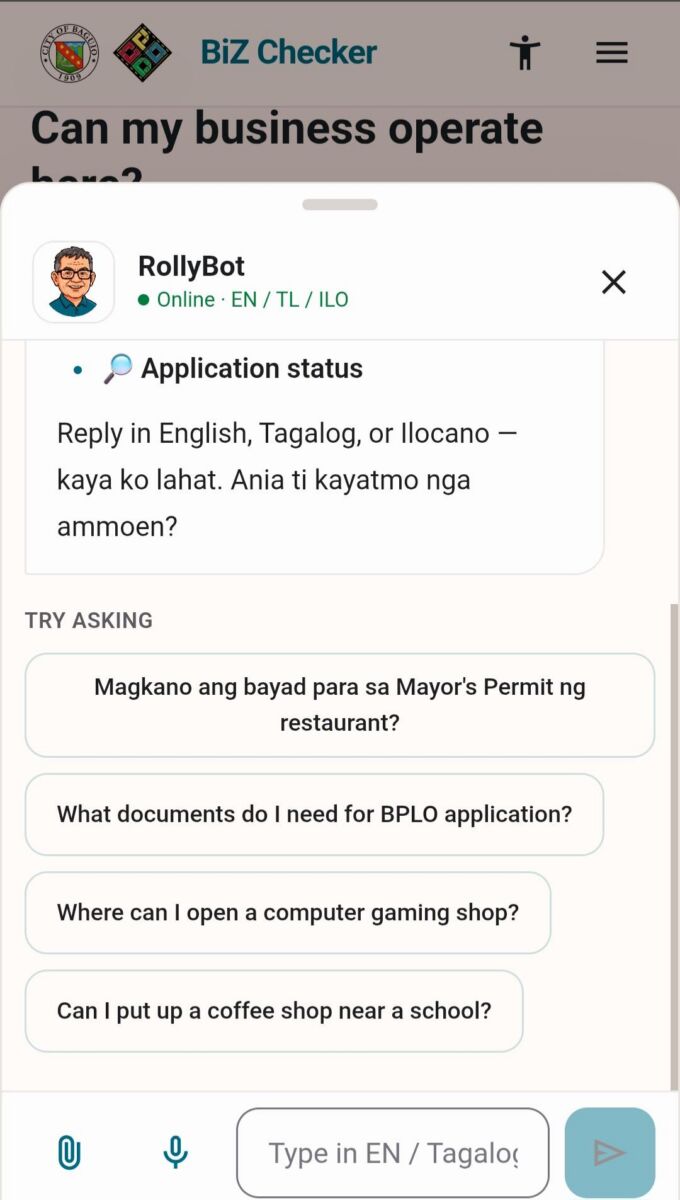
BIZ Checker also includes ‘Rolly Bot’, a chatbot that draws on government documents and data to provide information. During the pilot, Bautista said, even some people who were less familiar with technology were able to use the system through their phones.
“Some of them are non-techie, but when it comes to gadgets, even a few 60-year-olds are learning to use their phones to access the solution,” he said.
REFINING THE SYSTEM AFTER THE PILOT
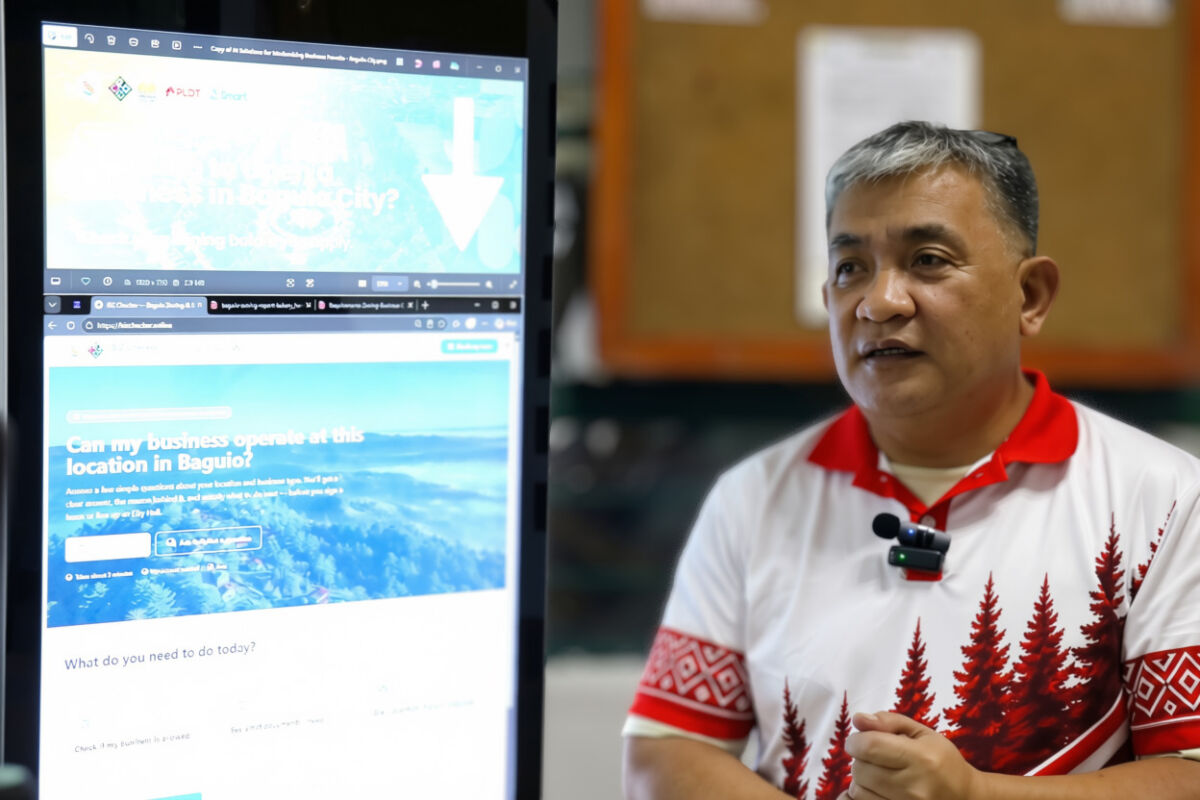
Testing the system also helped the city identify areas that still need refinement. Bryan Sombilon, senior project technical specialist of the Baguio City Planning, Development and Sustainability Office, said the team encountered additional permits and requirements that needed to be accounted for.
“We have to account for businesses that will be operating on government-owned properties. These are situations we encountered during the pilot, and now we know they also need to be reflected in the system,” he said.
The city is also reviewing its zoning rules, so the system will need to keep pace with regulatory changes.
“The city is updating some ordinances that date back to the 1990s to make them more relevant to current needs,” Bautista said. “When the new zoning ordinance is finished, we will put it into the system and update it.”
The team regularly reviews the system and makes corresponding changes when regulations or requirements evolve.
KEEPING IT SUSTAINABLE
For Sombilon, keeping the technology aligned with actual government processes is just as important as developing the tool itself. The team is looking at how to incorporate it into the city’s operations and sustain it over time.
“We need to institutionalize the system and integrate it into the government process. We need to plan for its sustainability, budgeting, and how it will be maintained as well,” he said.
The AI mentorship also influenced how the team approached the solution, pushing them to look beyond the technology and better understand the people who would use it.
“We were guided in terms of knowing more about our target audience, like their personas,” Sombilon said. “It’s really important when we craft the solution to know the personas of the target audience that we want to cater to.”
As the team prepares to present BIZ Checker at the PLDT and Smart’s AI in Action Summit in November, it continues to refine the system based on what it has learned from the pilot. The team hopes the technology can eventually make the permitting process more seamless, while keeping human support available when applicants need further explanation.
“Rolly Bot is there, but of course, we are always around to offer our services to Baguio City residents, especially those who prefer face-to-face interaction,” Bautista said.
For Sombilon, the project demonstrates how AI can be applied to a specific government service by using existing data and documents to make information more accessible to constituents.
“AI can really help make government processes easier,” he said. “We provide the system with data and documents from the government, allowing it to learn from the information we have and provide more accurate answers to constituents.”
BEYOND BAGUIO
Baguio City’s experience shows how local governments can explore AI as a practical tool for addressing specific service challenges. Through AI-in-a-Box, PLDT and Smart continue to support LGUs in developing solutions that respond to local needs, advance digital inclusion, and promote technology for good.
The country’s summer capital is one of four LGUs taking part in a mentorship program under the AI-in-a-Box initiative. Cebu City, Cabanatuan City, and the province of Lanao del Sur are also developing their own AI-powered tools to improve public service delivery.
The initiative also supports the United Nations Sustainable Development Goal 9 on Industry, Innovation and Infrastructure, which calls for fostering innovation and building resilient infrastructure to support inclusive and sustainable development.