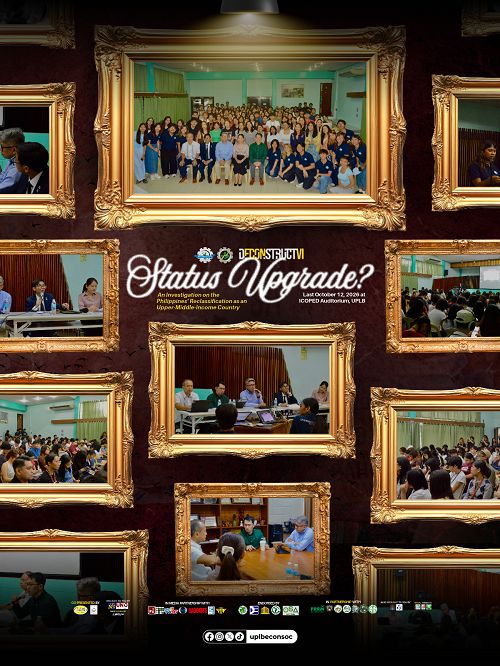

On October 12, 2026, the UPLB Economics Society gathered students and economists for Deconstruct VI at the ICOPED Auditorium with a single, urgent question: What does the Philippines’ new upper-middle-income status actually mean for the ordinary Filipino?
Moderated by Asst. Prof. Ma. Laarni Revilla, the panel featuring Dr. Jason Alinsunurin, Mr. Lance Avery Alo, Mr. Robert Dominick Mariano, and Mr. Roehlano Briones wasted no time dismantling the headline label. As Briones pointed out, the World Bank’s income tiers exist
primarily to determine eligibility for concessional loans, not to measure daily well being. “You don’t feel it,” he noted plainly. He urged the audience to grow the “buko pie” before arguing over slices, since social protection and free tuition cannot be funded from a shrinking one. His prescription: strengthen macroeconomic fundamentals before pursuing ambitious industrial policy.
Alinsunurin added that crossing the USD4,636 line is “not a development certificate.” Drawing on 2021 survey data, he showed that the top 10% of households claimed 27.6% of income while the bottom 10% received 3.2%. He also noted that three regions generate half the economy and that policy will not benefit all regions equally.
Alo questioned the celebration itself. With the Philippines ranking around 130th of 201 economies, he said, the milestone does not place our country in the global upper half. Families without Overseas Filipino Worker members report higher self-rated poverty (53% versus 34%),
which, in his view, reflects a low-wage domestic economy. He called for a serious rethinking of the development model and for less bureaucracy for business.
Mariano observed that the economy leapt from farms to services, with manufacturing at a 76- year low in 2025, and stressed that growth must be broad-based. Mariano noted that official development assistance makes up about 11.5% of the roughly PHP3 trillion the government plans to borrow in 2027, and the shift to market borrowing requires three years of sustained upper-middle-income status. He also pushed for deeper capital markets.
The open forum closed with a reminder to organize, engage in person, and remember that politicians come and go, but institutions stay.
Deconstruct VI highlighted the UPLB Economics Society’s ongoing commitment to driving evidence-based discourse on critical national issues. The Society extends its sincere gratitude to the panelists, moderator, and audience whose insights shaped the event. Follow the UPLB Economics Society on Facebook at facebook.com/uplbeconsoc for announcements on the next edition of Deconstruct.