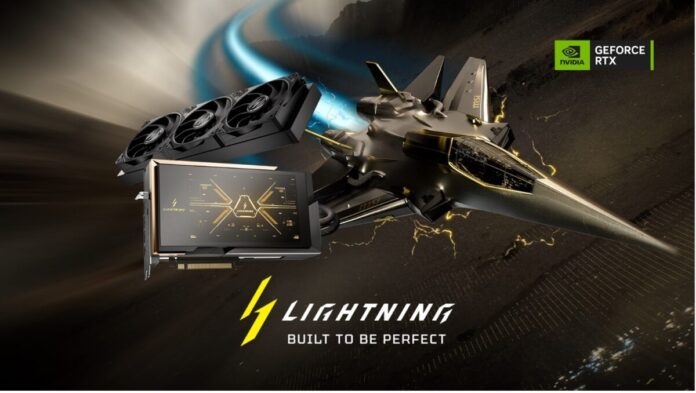

MSI left a distinctly different kind of statement on the CES 2026 show floor. Rather than presenting a broad vision of productivity, platforms, or lifestyle computing, MSI revived one of its most revered performance lineages with singular intent. The unveiling of the MSI GeForce RTX 5090 32G LIGHTNING Z marked the return of a flagship built not for mass appeal, but for the outermost limits of graphics engineering, overclocking, and design precision.
After seven years of silence, the LIGHTNING name re-emerged as MSI’s most powerful and technically ambitious graphics card to date. The RTX 5090 LIGHTNING Z was positioned as a pure expression of engineering without compromise, designed to showcase what is possible when performance ceilings are treated not as constraints, but as challenges to be overcome.
Built on NVIDIA Blackwell, Tuned for Extremes
At its core, the RTX 5090 LIGHTNING Z was powered by NVIDIA’s Blackwell-based GeForce RTX 50 Series architecture, delivering a massive increase in AI and graphics horsepower. MSI framed the card as an ultimate platform for elite gaming, advanced content creation, and experimental AI workloads, leveraging technologies such as NVIDIA DLSS 4, RTX AI accelerations, and next-generation rendering capabilities.
Rather than emphasizing mainstream performance gains, MSI focused on how the RTX 5090 LIGHTNING Z enabled unprecedented levels of compute density and responsiveness. From ultra-fast image and video generation to complex AI-driven workflows, the card was engineered to thrive in scenarios where conventional GPUs reach their limits.
When Engineering Became Visual Identity
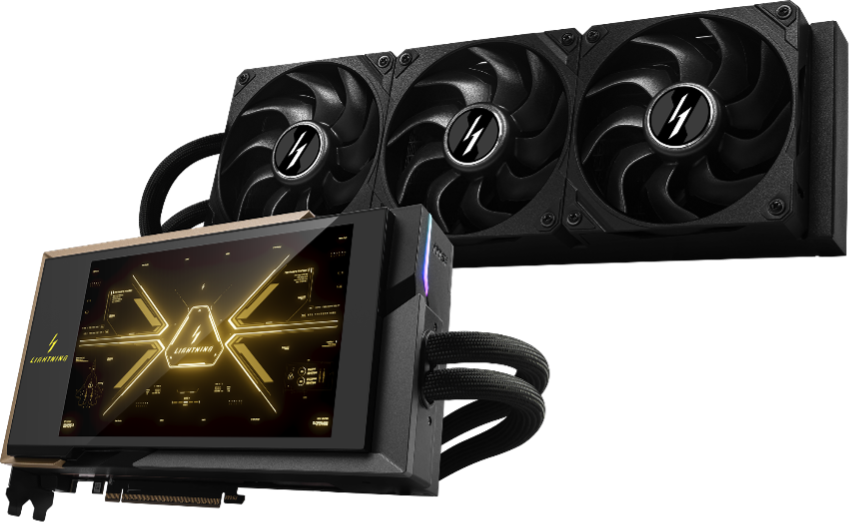
Visually, the RTX 5090 LIGHTNING Z represented the most dramatic evolution of the LIGHTNING design language to date. MSI introduced a full 8-inch integrated display panel, described as the world’s first of its kind on a graphics card. The display allowed full customization of system statistics, animations, and artwork through dedicated software, transforming the GPU into a centerpiece rather than a hidden component.
Carbon-fiber elements refined the backplate, paired with precision lightning-cut detailing and an individually numbered badge that emphasized the card’s rarity. Every design element reinforced the LIGHTNING Z’s status not only as a performance flagship, but also as a collectible statement piece within a high-end system build.
Liquid Cooling, Fully Realized
Beneath its sculpted exterior, MSI deployed the most advanced cooling system ever developed for a LIGHTNING graphics card. The RTX 5090 LIGHTNING Z featured a fully liquid-cooled thermal solution built around a full-cover cold plate spanning the GPU, VRAM, and MOSFETs to ensure even heat distribution under extreme workloads.
A next-generation high-pressure pump worked in tandem with a hybrid-fin radiator, engineered with alternating dense and sparse sections to create deliberate hot-and-cold exchange zones for maximum thermal efficiency. Completing the system was MSI’s exclusive Lightning Fan, designed with advanced aerodynamic geometry to deliver high airflow and static pressure while maintaining controlled acoustics. Together, these elements formed a cooling ecosystem purpose-built for sustained performance at the limits of modern GPU operation.
Power Delivery Designed to Break Barriers
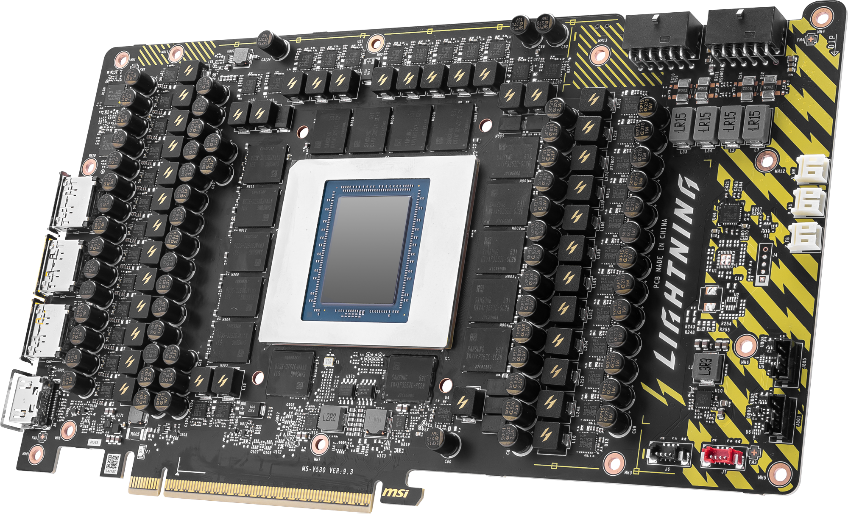
The RTX 5090 LIGHTNING Z’s engineering focus extended deep into its electrical and control architecture. MSI developed a custom PCB exclusively for the LIGHTNING line, reinforced with a 3oz copper layer and premium-grade components to ensure exceptional conductivity, thermal stability, and voltage integrity during extreme overclocking.
Dual BIOS support provided instant access to an enhanced performance profile tailored specifically for high-level overclocking scenarios. Complementing the hardware was MSI’s next-generation control ecosystem. Lightning Hub enabled web-based tuning of performance parameters, display content, and lighting effects without heavy software overhead, while the Lightning Overdrive mobile app offered real-time monitoring and overclocking control from virtually any device.
Proven at the Top of the Leaderboards
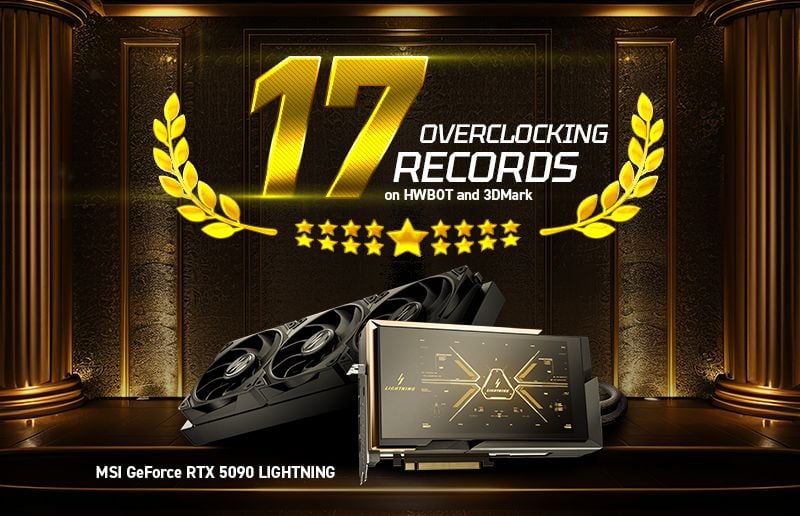
At its CES 2026 debut, MSI underscored the RTX 5090 LIGHTNING Z’s purpose with measurable results. The card claimed first-place positions across 17 overclocking benchmarks, setting multiple records on HWBOT and 3DMark. These included top scores in Geekbench 5 and 6, 3DMark Time Spy, Fire Strike variants, Port Royal, Speed Way, and GPUPI benchmarks
Rather than treating these achievements as marketing highlights, MSI positioned them as validation of the LIGHTNING philosophy. The RTX 5090 LIGHTNING Z was designed from the outset to operate beyond conventional limits, where stability, precision, and thermal control are critical under extreme conditions.
A Limited Global Showcase
MSI confirmed that the RTX 5090 LIGHTNING Z would be produced in a strictly limited run of just 1,300 units worldwide, with each card individually serialized. The limited production reinforced its role as a technical showcase rather than a volume-driven product, inviting elite overclockers and enthusiasts to push the platform even further.