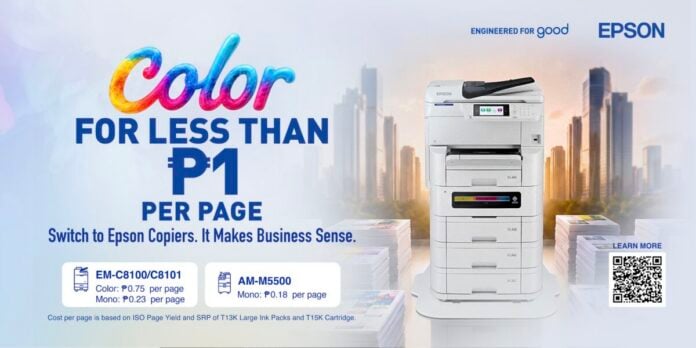

Businesses looking to reduce operating expenses often focus on major investments and recurring overhead, but everyday office printing can also contribute to energy consumption, maintenance requirements, and ongoing supply costs.
Epson Philippines is encouraging organizations to take a broader view of printing expenses by considering not only the upfront price of a printer, but also electricity use, replacement parts, maintenance, and the estimated cost of producing each page.
“Businesses should not have to choose between operating more efficiently and reducing their environmental impact,” said Noelle Gonzalez, head of marketing at Epson Philippines Corporation. “We believe the strongest sustainability solutions are those that also make good business sense.”
RETHINKING THE ENERGY BEHIND PRINTING
Conventional laser printers use heat in the printing process, including heating a fuser to bond toner to paper.
Epson’s PrecisionCore Heat-Free Technology takes a different approach, using piezoelectric technology to eject ink without applying heat during ink ejection.
According to Epson’s published comparisons, applicable Heat-Free models can use up to 85% less power and require up to 59% fewer replacement parts than comparable laser printers.
Actual results can vary depending on the specific printer model, print volume, settings, and operating conditions.
For businesses, lower power use can help reduce the energy required for everyday printing, while fewer replacement components can lower maintenance requirements over time.
LOOKING AT THE COST OF EVERY PAGE
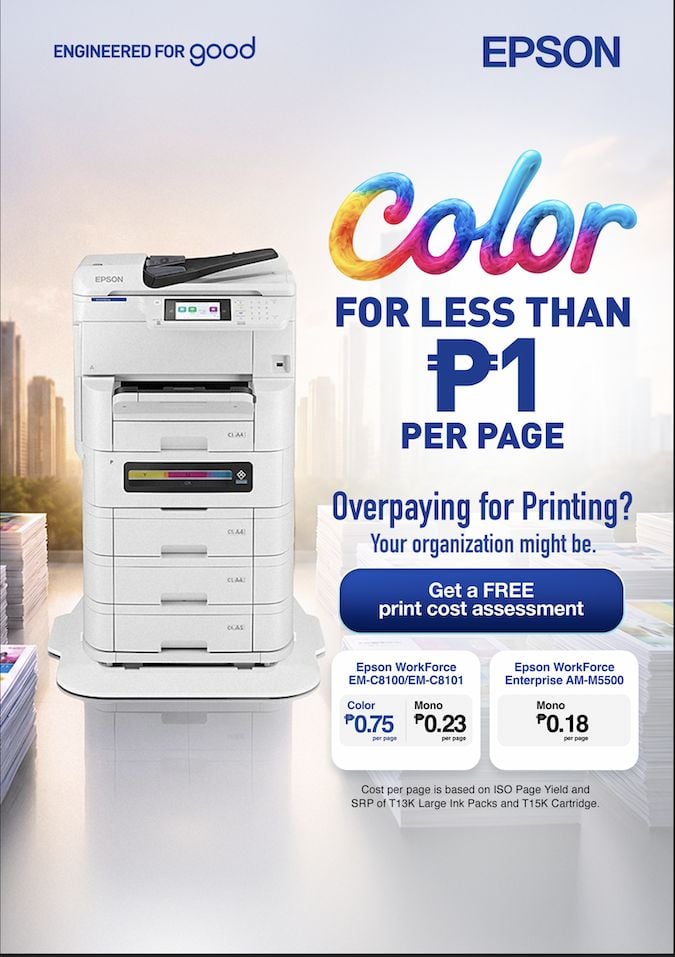
Energy and maintenance are only part of the printing equation. Ink remains a recurring expense, making cost per page, or CPP, another useful measure when evaluating a printer.
Epson’s low-CPP business copier portfolio includes the WorkForce Pro EM-C8100 and EM-C8101, with estimated ink costs of PHP0.75 per color page and PHP0.23 per black page.
The WorkForce Enterprise AM-M5500, meanwhile, has an estimated black printing cost of PHP0.18 per page.
These figures are based on the suggested retail prices of the relevant ink supplies and their ISO page yields.
CPP represents the estimated ink cost per ISO page. It does not include paper, electricity, maintenance, replacement parts, or the printer’s acquisition cost. Actual page yields may also vary depending on print content, printer settings, and usage conditions.
SMALL DIFFERENCES CAN ADD UP
A difference of only a few centavos per printed page may seem insignificant in a single transaction.
Across hundreds or thousands of pages, however, those differences can add up to a more meaningful operating expense, particularly for organizations with regular high-volume printing requirements.
This makes cost per page useful as one part of a broader evaluation of the long-term cost of running an office printer.
LOOKING BEYOND THE PURCHASE PRICE
A lower initial hardware price does not necessarily mean a printer will cost less over its entire service life.
Businesses can gain a more complete picture by considering upfront investment alongside recurring costs such as ink, power consumption, replacement components, and maintenance.
Looking at those expenses over time can help organizations compare printing solutions based on both initial cost and ongoing operational requirements.
MATCHING THE PRINTER TO THE WORKLOAD
The best printing setup depends on factors such as print volume, color requirements, workflows, and an organization’s existing printer fleet.
A smaller office with occasional printing needs may have different priorities from an enterprise environment producing thousands of pages every month.
For that reason, comparing cost per page alone may not provide the full answer. Energy use, reliability, maintenance requirements, print volume, and how the machine fits into existing workflows all contribute to total operating cost.
SAVINGS AND SUSTAINABILITY CAN OVERLAP
Epson also positions lower-energy printing as part of a broader sustainability strategy.
By reducing power consumption and potentially lowering the number of replacement components required during operation, applicable Heat-Free models address both operating efficiency and resource use.
For businesses, that creates an opportunity to assess environmental objectives alongside financial considerations rather than treating sustainability as a separate cost.
FREE PRINT COST ASSESSMENT
Epson offers businesses a free print cost assessment to help evaluate their current printing environment.
An Epson specialist reviews an organization’s existing printer fleet and operating expenses, including cost per page, energy consumption, maintenance, and replacement requirements. The assessment then calculates potential savings from moving to an eligible high-yield Heat-Free printing solution.
The Epson WorkForce Pro EM-C8100, EM-C8101, and WorkForce Enterprise AM-M5500 are available through authorized Epson Philippines dealers and partners nationwide.