
Viettel Cyber Security’s Q3 2026 Cyber Threat Report shows rising phishing, data breaches, and ransomware, putting operations, finances, and sensitive data at risk for Philippine businesses
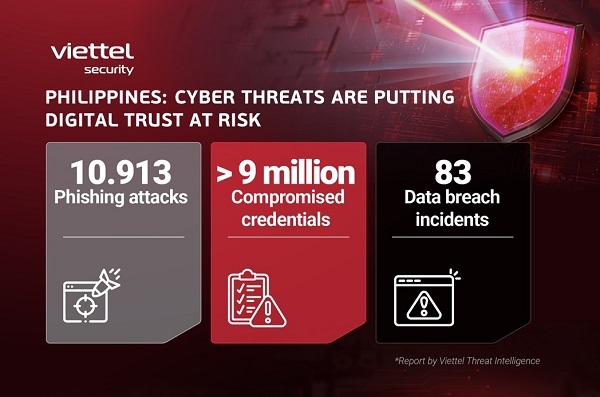
Cyber threats facing Philippine organizations continue to intensify, with more than 9 million compromised credentials recorded in the third quarter of 2026. Government entities, financial institutions, and consumer services were among the sectors most affected by data breaches, according to the latest Cyber Threat Landscape Report from Viettel Cyber Security (VCS).
The report, which examined cyber threat activity across the Philippines from July to September, recorded 10,913 phishing attacks and 83 data breach incidents exposing 85.9 million records. Ransomware incidents also increased across transportation, manufacturing, hospitality and tourism, financial services, and healthcare.
“Attackers today don’t need to break in when they can simply log in. With more than 9 million Philippine credentials compromised in a single quarter, a stolen password has become one of the cheapest ways into a company’s network. The real question for business leaders is no longer whether their accounts have been exposed, but whether they would notice when someone else starts using them,” said VCS country manager Thomas Luu.
CYBER THREATS GROW IN SCALE AND SOPHISTICATION
Phishing attacks in the Philippines reached 10,913 in Q3 2026, up 43 percent year over year. The banking, financial services, and insurance (BFSI) sector accounted for 29 percent of recorded attacks, followed by government impersonation at 24 percent and social media-related threats at 16 percent. Cybercriminals are increasingly using AI-generated deepfakes to impersonate trusted authorities and make fraudulent schemes more convincing.
Credential theft remains another significant concern. The number of compromised credentials linked to Philippine users more than doubled from 4.3 million in Q3 2025. This brings the year-to-date total to over 28.3 million, nearly three times the figure recorded throughout 2025.
According to VCS, the growing commercialization of stolen credentials is making cyberattacks more accessible. Through the Stealer-as-a-Service model, criminals can rent information-stealing tools and trade compromised credentials, enabling further attacks such as account takeovers, business email compromise, and ransomware intrusions.
Meanwhile, ransomware incidents nearly quadrupled year over year, rising from five in Q3 2025 to 19 in Q3 2026. Transportation and logistics recorded the highest number of incidents, followed by manufacturing, with other attacks affecting hospitality, financial services, and healthcare.
THE BIGGEST INCIDENTS
The report also highlighted several significant incidents involving sensitive personal and organizational information:
- Six online lending platforms experienced data breaches involving approximately 32 million records.
- An incident affecting the transportation sector exposed 16 million records.
- Separate attacks involving public institutions and healthcare facilities compromised identity documents and internal systems, including hospital data covering more than 3.5 million files.
These incidents illustrate how cyber threats extend beyond data exposure, potentially enabling unauthorized access to critical systems, financial losses, operational disruptions, and reputational damage.
STRENGTHENING CYBERSECURITY READINESS FOR 2027
As cyber threats evolve, VCS emphasizes the need for Philippine organizations to move beyond reactive cybersecurity measures and adopt a more proactive approach to identifying and addressing vulnerabilities.
The report recommends stronger account protection, continuous threat monitoring, timely software updates, regular data backups, and improved incident response capabilities. Organizations are also encouraged to assess third-party security risks and strengthen employee awareness to minimize potential entry points for attackers.
“What we often see on the ground is that organizations only discover an attack after the damage is done. Going into 2027, the businesses that stay ahead will be those that treat cybersecurity as a leadership priority reviewed regularly, not an IT problem fixed after an incident. Knowing where you are exposed before attackers do is now a basic business requirement,” Luu added.
For deeper insights into emerging cyber threats and practical recommendations to strengthen organizational defenses, access the full VCS Cyber Threat Landscape in the Philippines Q3 2026 report.