
The free Filipino-made app uses age-based learning modes to teach children how AI works, where it can fail, and why human judgment still matters.
Ask a child what artificial intelligence does and the answer may be simple: it helps with homework, answers questions, or generates images. Ask how it works, why it sometimes gets things wrong, or what happens to personal information after it is uploaded, and the picture quickly becomes less clear.
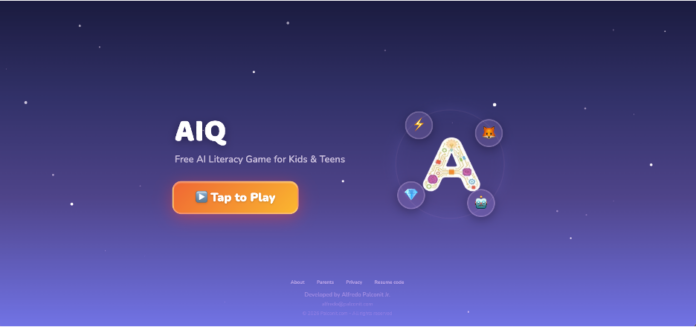
That gap is what AIQ is trying to address. Built independently by Quezon City developer Alfredo Palconit Jr., the free web app is designed to teach AI literacy to children ages 5 to 18, with a focus on understanding the technology rather than simply depending on it.
Four interfaces for four age groups
AIQ does not use the same interface for every child. Instead, it changes according to age and developmental stage.
Younger learners start with Explorer Mode, which uses a fox mascot named Pixel, oversized buttons, gold stars, and no leaderboard. Older children move into Builder Mode, where they encounter XP, badges, optional squads, and a mascot named Axiom.
For early high school students, Hacker Mode introduces a darker interface, neon accents, competitive leagues, and a mascot named Nova. By ages 15 to 18, Architect Mode drops the mascot entirely and shifts toward portfolios and certificates that feel more relevant to older students preparing for further study or future work.
The different layers are designed around the idea that a five-year-old and a fifteen-year-old should not be taught the same way, even when the underlying subject is identical.
A 36-lesson AI literacy curriculum
Underneath the four interfaces is one 36-lesson curriculum built around AI4K12’s “Five Big Ideas in AI” framework.
The lessons explore how machines perceive, learn, reason, interact, and affect society. Students are introduced to practical examples such as recommendation systems, chatbot hallucinations, and situations where machine judgment should not be treated as the final answer.
That approach makes AIQ less about teaching children to prompt a chatbot and more about helping them understand what is happening behind the interface.
Palconit describes the philosophy as being “AI-native, not AI-dependent.” The distinction is central to the app: children are encouraged to understand how AI systems work while still doing the thinking, creating, and problem-solving themselves.
Built around privacy from the start
AIQ is also designed to minimize the amount of personal information collected from children.
The app does not require an email address, real name, birthdate, or photo. Progress is saved locally on the device, allowing a child to remain anonymous throughout normal use.
For classroom use, teachers can generate class codes so students can synchronize progress and identify areas where the group may need more help. Even then, students use only a nickname and four-digit PIN rather than a full identity.
The app also contains no advertising and no in-app purchases.
“AIQ has no budget, on purpose,” Palconit said. “If it needs money to keep running, eventually it either shuts down or starts running ads at kids. Neither is acceptable, so the constraint is: it has to be free forever.”
Designed for the devices kids already use
AIQ is delivered directly through a mobile browser, so users do not need to install it from an app store.
Its initial load is under 70KB, helping it run more easily on budget Android phones and slower or less reliable data connections. The app is available in both English and Filipino.
That lightweight approach is especially relevant in a market where not every child has access to a high-end phone, tablet, or always-on broadband connection.
A practical companion to AI education
The app arrives at a time when AI literacy is becoming a more formal part of the education conversation in the Philippines.
The material cites DepEd’s Project AGAP.AI and DepEd Order No. 003, s. 2026 as part of the broader push toward AI literacy in schools. AIQ takes a different but complementary approach by giving children something they can use outside the classroom, without requiring a teacher, subscription, or account.
“There’s a lot of guidance now for teachers on how to bring AI into the classroom,” Palconit said. “But almost nothing a parent can just hand their kid at home, for free, that actually teaches how AI works instead of just letting them use it.”
AIQ is available now at aiq.ph.