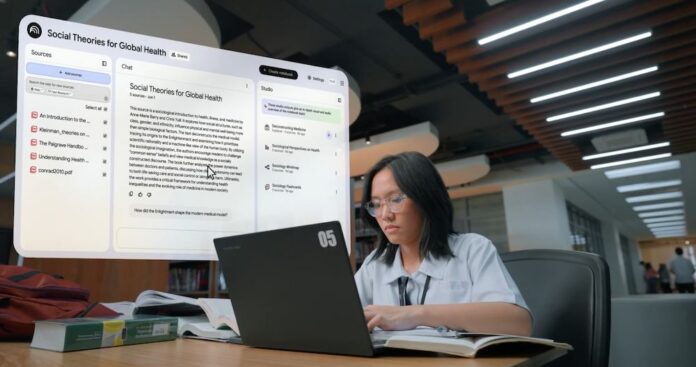

The university is using Google AI tools across teaching, research, and learning, supported by faculty training and responsible-use guidelines.
The University of Santo Tomas is expanding its use of artificial intelligence across campus through Gemini for Education, integrating generative AI into teaching, learning, research, and academic support.
The rollout covers UST’s more than 46,000 students across 22 degree-granting academic units and builds on the university’s earlier adoption of Google Workspace for Education. More than 2,000 faculty members have been trained to use AI in ways relevant to their disciplines, supported by 45 e-learning specialists embedded across colleges and more than 300 Google Certified Educators.
Training faculty before scaling AI use
UST’s approach centers on preparing educators before expanding the tools more broadly.
Led by the university’s Educational Technology Center, the program gives faculty practical guidance on how to use Gemini and Gemini Notebook within their own subject areas rather than applying the same approach across every discipline. UST has also established guidelines for responsible AI use to help ensure the technology supports academic integrity and ethical standards.
“At the Educational Technology Center, our mandate is to integrate technology tools for teaching, learning, research, and community service,” said Asst. Prof. April Joy M. Gascon, acting director of the UST EdTech Center.
“Each of our e-learning specialists brings their own stories and contexts on how technology best serves their specific discipline.”
Different uses across different disciplines
The way Gemini is used varies considerably depending on the course.
In nursing, faculty members can create realistic patient-care scenarios that allow students to practice emergency decision-making before entering hospital settings. In architecture, AI visualization turns concepts into more realistic renders, including designs that reflect vernacular Philippine architecture.
In engineering, teachers use AI to create visual representations of complex mathematical formulas and spatial concepts. In theology, students use Gemini Notebook to synthesize dense historical and philosophical readings, freeing up classroom time to focus on discussion, ethics, and human values.
“Ever since we started using Google AI, classroom dynamics have changed for the better because students can now demonstrate their learning in transformative ways,” said Shane Alexander Y. Laong, team leader for e-learning specialists at UST.
“When Gemini Notebook was integrated, it definitely lessened the workload for both teachers and students, allowing them to turn mountains of literature into flashcards, quizzes, and review materials that make learning more engaging.”
Giving educators more time for mentoring
AI is also being used for routine academic preparation, including drafting lesson plans, designing rubrics, and creating visual guides.
Reducing the time spent on repetitive tasks can give faculty more room for face-to-face mentoring, personalized feedback, and other forms of direct student engagement. In that sense, UST is positioning AI as a support layer around teaching rather than as a replacement for the educator.
“I strongly encourage my fellow educators to set aside their fears of AI. Understand what it does, understand its impact on instruction, and redesign teaching to make it more purposeful and relevant for students,” said Prof. Cheryl R. Peralta, DrPH, UST vice rector for academic affairs.
“We aim to produce Thomasian graduates who are future-ready, competent, committed, and compassionate, empowered to use critical thinking, problem-solving, and AI ethically and responsibly.”