

Filipino professionals are emerging as some of the most advanced users of AI at work, according to the 2026 Microsoft Work Trend Index Annual Report. The study found that 25% of Filipino workers surveyed qualify as “Frontier Professionals,” compared with a global average of 16%.
Microsoft defines Frontier Professionals as workers who routinely use AI agents for multi-step workflows, rethink business processes, and help establish new standards for AI-assisted work. The report, titled Agents, Human Agency, and the Opportunity for Every Organization, draws on a survey of 20,000 workers using AI across 10 markets, later extended to 11 additional markets including the Philippines, as well as trillions of anonymized Microsoft 365 productivity signals.
Filipinos say AI is expanding what they can do
Among Filipino AI users, 77% said they are producing work they could not have produced a year ago, compared with 58% globally. Among Filipino Frontier Professionals, the figure rises to 86%.
The findings suggest that AI is increasingly being used not only to speed up routine tasks but also to expand the range of work employees can perform. Microsoft summarizes this shift in the report by saying AI is “expanding who can do high-value work.”
Human judgment remains central
Despite higher AI adoption, Filipino respondents placed strong emphasis on human skills and accountability. Sixty-five percent said critical thinking is the most important human capability as AI takes on more work, the highest share among the markets surveyed and well above the 46% global average.
Another 59% identified quality control of AI output as a top priority, compared with 50% globally. At the same time, 93% said they treat AI output as a starting point rather than a final answer and remain responsible for the thinking, compared with 86% globally.
Filipino Frontier Professionals also appear more deliberate about maintaining their own expertise. Fifty-three percent said they intentionally complete some work without AI to keep their skills sharp, compared with 42% of non-Frontier users, while 61% pause before starting a task to decide what should be handled by AI and what should remain human-led.
“The Philippines is showing what the next chapter of AI adoption can look like when people combine ambition with judgment, accountability, and practical execution,” said Mayank Wadhwa, president of Microsoft ASEAN. He added that organizations now need to move from experimentation toward trusted platforms, governance, responsible AI practices, and workforce skills that support everyday AI use.
The ‘Transformation Paradox’
Microsoft describes a gap between individual AI adoption and organizational readiness as the “Transformation Paradox.” In the Philippines, 35% of AI users said their leadership is clearly and consistently aligned on AI, higher than the 26% global average, but still representing only around one in three workers.
At the same time, 66% said they worry about falling behind if they do not adapt quickly to AI, while 53% said it feels safer to focus on current priorities than to redesign work around AI. Only 25% said they are rewarded for reinventing how they work, although that is nearly twice the 13% global average.
Managers and team culture influence AI adoption
Frontier Professionals in the Philippines reported stronger support from their managers than non-Frontier users. Eighty-six percent said their managers openly use AI, compared with 78% of other workers, while the same proportion said their managers set quality standards for AI-assisted work, compared with 75%.
They were also more likely to say managers create space for experimentation and encourage more ambitious approaches to redesigning work. Team behavior followed a similar pattern: 74% of Frontier teams regularly brainstorm and refine business processes to identify AI opportunities, versus 55% among non-Frontier teams.
Microsoft’s analysis found that organizational factors such as culture, manager support, and talent practices account for 67% of the difference in AI transformation outcomes, compared with 32% attributed to individual mindset and behavior.
PLDT and Smart move AI into everyday workflows
Microsoft also highlighted PLDT and Smart as an example of how organizations are moving AI beyond isolated pilots. The companies recently deployed 1,000 Microsoft 365 Copilot seats as part of a broader effort to integrate AI into day-to-day work.
“At PLDT and Smart, AI is not just a technology rollout. The real opportunity is to rethink how work gets done, so our teams can simplify processes, respond faster, and create more meaningful value for customers,” said Gilbert Gaw, first vice president and head of information technology and the Transformation Office at PLDT and Smart.
He added that AI creates business impact when it becomes part of regular workflows and is supported by training, governance, and workforce adoption.
Organizations are becoming ‘Learning Systems’
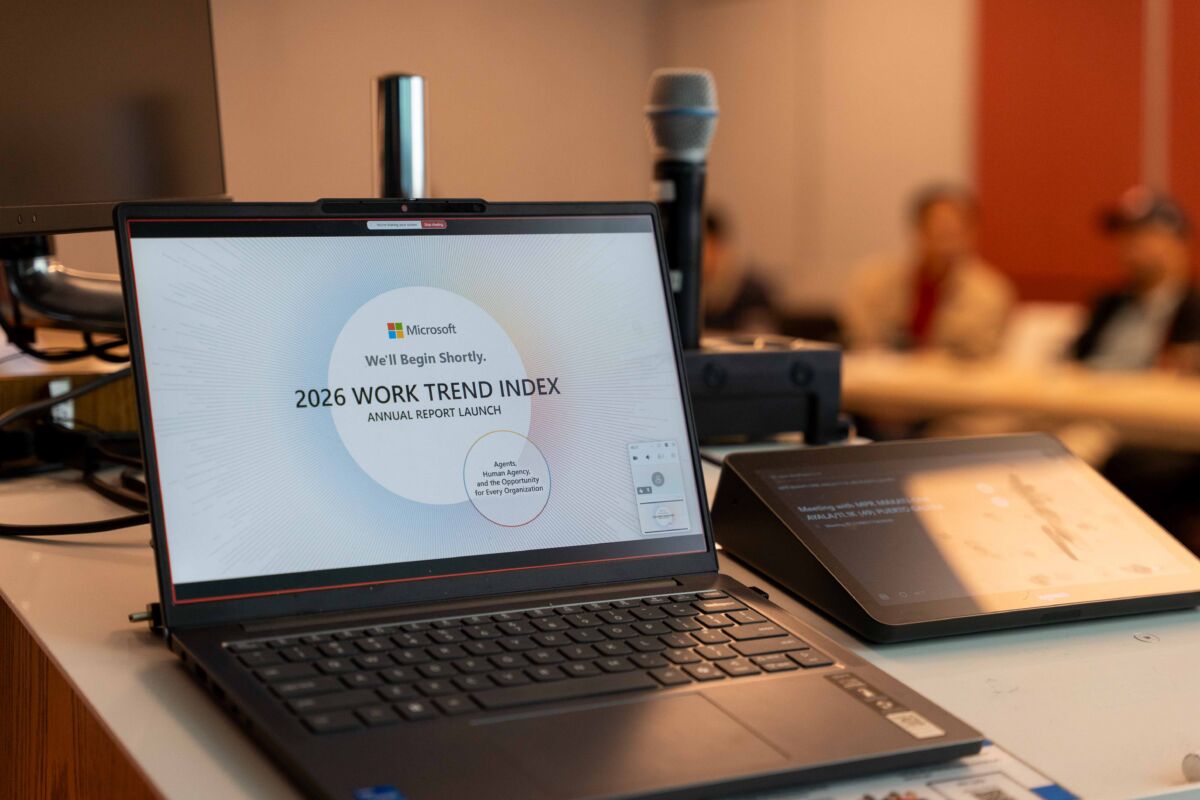
The report argues that organizations need to do more than deploy AI tools. Microsoft says they should also redesign how work is structured and how knowledge gained from AI use is shared across teams.
AI agents have grown 15 times year over year across the Microsoft 365 ecosystem and 18 times in large enterprises, according to the report. Microsoft uses the term “Learning System” to describe organizations that can capture, share, and scale what employees learn from working with AI.
For the Philippines, the findings point to a workforce that is already showing relatively high AI readiness and strong human judgment. The next challenge is translating individual momentum into consistent, trusted, and scalable ways of working across entire organizations.
In Summary
Microsoft’s 2026 Work Trend Index found that 25% of Filipino AI users qualify as Frontier Professionals, compared with 16% globally, while 77% say AI helps them produce work they could not have produced a year ago. Filipino respondents also placed strong emphasis on critical thinking, quality control, and retaining human responsibility for AI-assisted work. The report argues that the next stage of AI transformation will depend less on individual adoption alone and more on organizational culture, leadership, governance, and incentives.