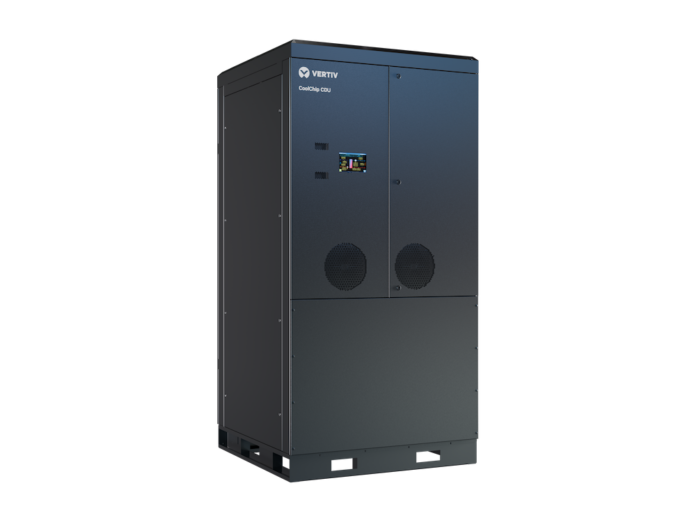

Vertiv has announced that its 2.3MW CoolChip CDU 2300 has qualified as NVIDIA DSX Ready, extending the company’s liquid-cooling portfolio for edge, colocation, and hyperscale AI deployments.
The 2.3MW model is the first coolant distribution unit to qualify specifically as NVIDIA DSX Ready, according to Vertiv. The program helps AI factory builders identify power and cooling products that meet applicable NVIDIA DSX requirements.
COOLING FOR HIGH-DENSITY AI SYSTEMS
A coolant distribution unit, or CDU, manages the flow and temperature of liquid used to remove heat from high-density computing systems.
The Vertiv CoolChip CDU 2300 is part of the company’s liquid-to-liquid CDU portfolio and supports both direct-to-chip cooling and rear-door heat exchanger applications. It is designed for installation either at the end of a row or along the perimeter of a data hall.
As AI computing densities rise, thermal management is becoming more closely tied to power, networking, and facility design.
“The scale of AI deployment is forcing a more integrated approach to data center infrastructure,” said Scott Armul, chief product and technology officer at Vertiv.
“Compute, power, and cooling decisions can no longer be made independently. A constraint on any one of those systems can limit the performance and productive capacity of the entire facility.”
NVIDIA DSX READY PROVIDES A QUALIFICATION FRAMEWORK
The NVIDIA DSX AI Factory Platform unifies AI factory planning and operations across compute, networking, power, cooling, facilities, and software.
Within that framework, NVIDIA DSX Ready connects specific infrastructure products with applicable DSX requirements. For coolant distribution units, the program uses the NVIDIA CDU self-qualification suite to determine whether a particular product meets the relevant functional requirements.
Vertiv says this gives AI factory builders a more consistent basis for evaluating cooling infrastructure as part of a larger system design.
QUALIFICATION DOES NOT REPLACE SITE ENGINEERING
The DSX Ready designation does not mean a qualified CDU can simply be installed into any AI data center without further engineering.
Individual operators still need to determine whether the product fits their facility design, system configuration, power and water constraints, cooling architecture, and operating requirements.
This distinction is particularly important for AI infrastructure, where high-density compute can place significant demands on cooling capacity and facility-level integration.
INTEGRATING COMPUTE, POWER, AND COOLING
AI factories are data centers designed to develop and operate AI models and applications at scale. As compute density increases, builders have to account for power availability, cooling capacity, water use, site conditions, and grid constraints as interdependent factors.
Vertiv positions the CoolChip CDU 2300 as one of the thermal building blocks for these environments, supporting liquid-cooling architectures intended to remove heat from high-density hardware more efficiently than conventional room-level cooling alone.
“The qualification of Vertiv’s 2.3 MW CDU model reflects our continued focus on providing the thermal building blocks, engineering expertise and lifecycle support customers need as they plan and operate increasingly complex AI environments,” Armul said.
EXPANDING LIQUID COOLING FOR AI INFRASTRUCTURE
The qualification adds to Vertiv’s broader portfolio of power, cooling, IT infrastructure, and services for critical digital applications.
For AI factory operators, the significance lies less in the qualification as a standalone certification and more in having cooling hardware that can be evaluated within a broader NVIDIA-defined infrastructure framework.
As AI deployments continue moving toward denser and more power-intensive configurations, coolant distribution units are becoming a more central part of data center architecture, connecting facility-side cooling systems with liquid-cooled computing equipment.
More information about Vertiv’s infrastructure and cooling portfolio is available through the Vertiv website.