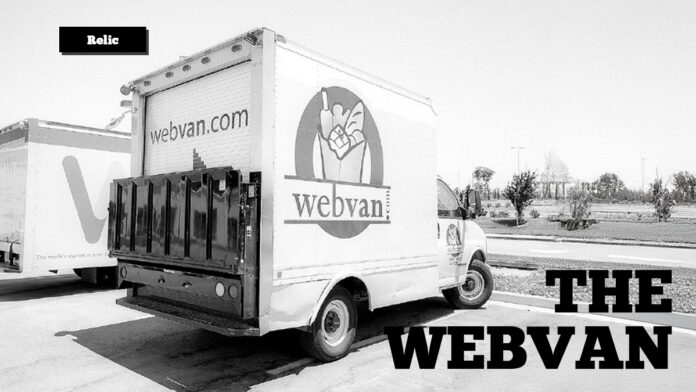

The Internet has (for better or worse) made all things possible. From being able to hitch a ride with your smartphone to getting food delivered to watching episodes of your favorite TV shows, the truth is that the Internet has given opportunity, entertainment, and many other things to people from all walks of life. During the COVID-19 pandemic, many people ordered groceries online in an effort to reduce the spread of the virus, but the idea of ordering groceries online is older than you might think. Enter WebVan, an ambitious idea from the late 1990s that allowed you to order groceries directly to your home. Was it a sign of what was to come, or just another quirky idea that came out of the tech hub of Silicon Valley?
Like many topics covered in Relic, some ideas come before their time, and Webvan is no exception. The idea of ordering things online was a novelty in the 1990s. Amazon opened for online shopping in 1995, but it was only for books, and did not sell anything else until late 1999 to early 2000. Webvan was the brainchild of Louis Borders. Borders was also the founder of Borders, a bookstore chain founded in 1971. Borders, who already knew a thing or two about business through the Borders bookstores, sought to cash in on the dot-com boom by attempting to eliminate the need to go grocery shopping at physical locations.
Webvan was based in Foster City, California, and delivered groceries o customers’ homes within a 30-minute window of their choosing. Keep in mind that this was 1996—smartphones were still around a decade away and Internet access was in its infancy. Yet, in the dot-com boom, any idea was conceivable and marketable to investors, including Webvan. Service was only limited to the San Francisco Bay Area at first, but expanded to other major American cities such as other major cities in California (Sacramento, Los Angeles, Orange County, San Diego), the Pacific Northwest (Seattle and Portland), the Midwest (Chicago), Dallas, and Atlanta. Before its collapse, it was expected to expand to 26 cities by 2001.
Like any startup with investors and stakeholders, growth was key. However, how one goes about that growth determines if startups succeed or fail. Webvan’s investors demanded rapid growth when the infrastructure needed for that growth was still developing in a country where growth is uneven. Orders started in June 1999 in the San Francisco Bay Area. Webvan made a USD1 billion deal (USD2.022 billion in 2026) with Bechtel to build warehouses, as well as procured delivery trucks. In 2000, they bought a competitor, HomeGrocer, for around USD1.2 billion (USD4.449 billion in 2026). 2000 was also Webvan’s peak, but the balance sheet would say otherwise: USD178.5 million in sales against USD525.4 million in expenses was a result of the demand to expand quickly without considering the environment that this expansion is taking place.
It is not unheard of for companies to operate for years without turning a profit. Uber is one of the biggest examples, not turning a profit for 14 years until 2023. However, in the “fail fast” environment of the dot-com boom, Webvan was another victim of being ahead of its time. Webvan was valued at nearly USD4.8 billion in 1997. In addition, none of Webvan’s leadership had experience in the supermarket industry, including CEO George Shaheen. Shaheen’s contract required Webvan to pay him USD375,000 for life. While this is not a huge amount even by late 1990s standards, the cascading number of losses can be attributed to several factors: a failure to prove its business model in its initial market; a business model that targeted price-sensitive mass-market consumers (as opposed to the more profitable upmarket consumers); and building its own warehouses and fulfillment infrastructure from scratch, which greatly impacted their expenses (as opposed to partnering with already-existing providers). The company ceased to exist in 2001 with losses of over USD800 million. All the non-perishable food was donated to food banks.
What happened to CEO George Shaheen and all of its employees? Some went to work for Amazon, taking Webvan’s blueprint with them to help Amazon grow into the giant it is today. Despite CNET naming Webvan one of the biggest dot-com bubble failures, Shaheen managed to secure another CEO position at Siebel Systems from 2005 until Cisco acquired it in 2006. He even became parodied in the cartoon Bigtime Consulting, a jab at his previous job at Andersen Consulting (now Accenture) as the CEO character George Unseen. Many companies copied the Webvan concept during the COVID-19 pandemic, as previously mentioned, including Instacart and others.
C
Words by Jose Alvarez
Also published in GADGETS MAGAZINE Volume 27 Issue No. 4