
A 25-country survey shows security, risk, and governance is the number one factor leaders weigh when deploying AI
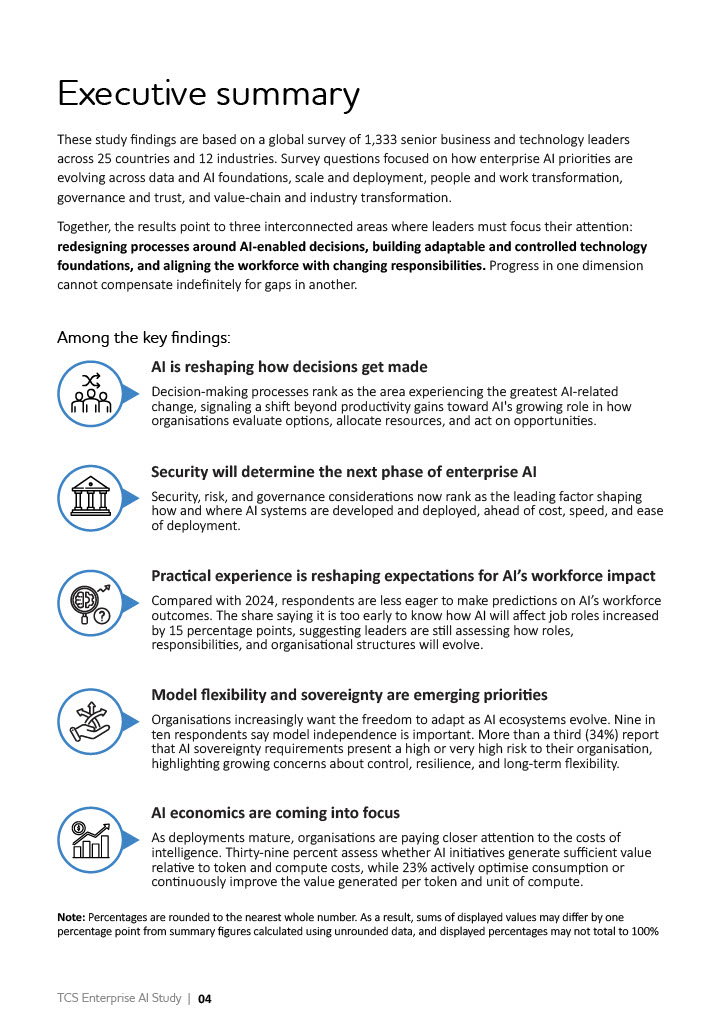
Eighty-four percent of executives surveyed rank productivity improvement as the leading source of value realized from AI investments, yet only 10 percent of global enterprises allow AI agents to execute decisions without human approval across multiple functions or business areas. The finding comes from a new global study by Tata Consultancy Services (TCS), a global IT services, consulting, and business solutions company.
The study also finds that just 9 percent of executives report AI agents capable of securely orchestrating workflows across enterprise applications. The findings highlight the gap between the value that enterprises are already getting from AI-assisted work and their readiness to give AI agents greater autonomy and authority to act.
SECURITY TAKES THE LEAD
The study, TCS Enterprise AI Study: Intelligence that is Real, highlights security as a defining factor in the next phase of enterprise AI. Security, risk, and governance considerations rank as the leading factor shaping how and where AI systems are developed and deployed, ahead of cost, speed, and ease of deployment. That emphasis is becoming increasingly consequential as enterprises give AI greater access to applications, workflows, and decision-making processes.
The findings reflect the evolution toward a Human+AI operating model, where AI progresses from assisting employees to taking on greater responsibility and, where appropriate, operating with increasing levels of autonomy. As enterprises move along that continuum, deriving greater value from AI will depend on having the right security, governance, and controls in place to determine where human oversight remains essential and where AI can be given greater authority to act.
“We are seeing significant progress in scaling AI for enterprises. The shift is clearly in AI moving from assisting people to taking more autonomous action with deep access into an enterprise. Productivity is clearly where enterprises are seeing the greatest value from AI today, with 84% of executives ranking it as the leading source of value from their AI investments though 10% have also indicated that they have seen an uplift in revenue. What seems to be holding organizations back, and rightly so, are concerns around security, governance, and resilience. Deploying AI responsibly, with the right guardrails and enterprise controls will be the big focus in the next stage of this journey,” said Amit Kapur, chief AI and services transformation officer at TCS.
PLATFORM INDEPENDENCE AND AI SOVEREIGNTY
Executives are also increasingly focused on AI resilience and flexibility. Ninety percent of respondents say that model independence is an important factor in AI investment decisions, while 34 percent identify AI sovereignty-related requirements involving control over data location, model choice, and compliance as a high or very high organizational risk.
The concern is particularly acute in Europe, where 43 percent of respondents cite AI sovereignty-related requirements as a high or very high organizational risk. At the same time, only 7 percent of global respondents report having organization-wide provider-switching continuity plans, suggesting that concern about model dependence and sovereignty is advancing faster than operational preparedness.
OTHER KEY GLOBAL FINDINGS
- AI economics are under review: 39 percent of enterprises said they continue to assess whether AI initiatives generate sufficient value relative to token and compute costs.
- Enterprise knowledge remains fragmented: 44 percent of respondents report that important business knowledge remains embedded within employees or fragmented documentation, potentially limiting AI’s ability to consistently access enterprise context.
- Open-source AI is gaining traction: 46 percent report targeted deployment of open-source AI for selected use cases.
- AI’s workforce impact is becoming less predictable: The proportion of leaders saying it is still too early to determine AI’s effect on jobs rose from 4 percent in 2024 to 19 percent in 2026.
- Productivity remains the leading source of AI value, followed by improvements in customer experience and the development of new products or services.
REGIONAL AI PRIORITIES AND READINESS VARY
The study also identified notable regional differences in enterprise AI adoption. North America showed particular strength across several enterprise AI foundations, with 15 percent of respondents reporting that AI is treated as a strategic enterprise capability. Europe showed a strong focus on AI sovereignty, with 43 percent citing sovereignty-related requirements as a high or very high organizational risk. Meanwhile, the UK and Ireland stood out on operational resilience, reporting comparatively strong levels of AI continuity planning and governance integration.
The full report is available at TCS Enterprise AI Study: Intelligence that is real.