
A new report from Kaspersky sheds light on the growing prevalence of tech-enabled abuse, revealing that while nearly half of adults have experienced some form of digitally facilitated harm, only a minority fully understand what the term means.
The study explores how technology is increasingly being used to enable harassment, exclusion, impersonation, cyberstalking, unauthorized monitoring, and other forms of abuse. It also examines the evolving stalkerware landscape and the growing availability of surveillance and doxing services online.
Understanding tech-enabled abuse
Tech-enabled abuse, also known as technology-facilitated abuse, refers to abusive behavior carried out or amplified through digital technologies such as smartphones, social media platforms, messaging applications, and online services.
Because these behaviors are often embedded within everyday digital interactions and may leave little visible evidence, many people fail to recognize them as abusive. As a result, harmful conduct can be normalized, overlooked, or left unreported.
A significant awareness gap
According to Kaspersky’s global study, only 32 percent of respondents said they understood the meaning of technology-facilitated abuse. However, 45.7 percent reported experiencing at least one form of tech-enabled abuse during the previous 12 months.
The findings suggest that many people may be experiencing abusive digital behavior without recognizing it as such. Among those affected, respondents encountered an average of 2.7 different forms of abuse.
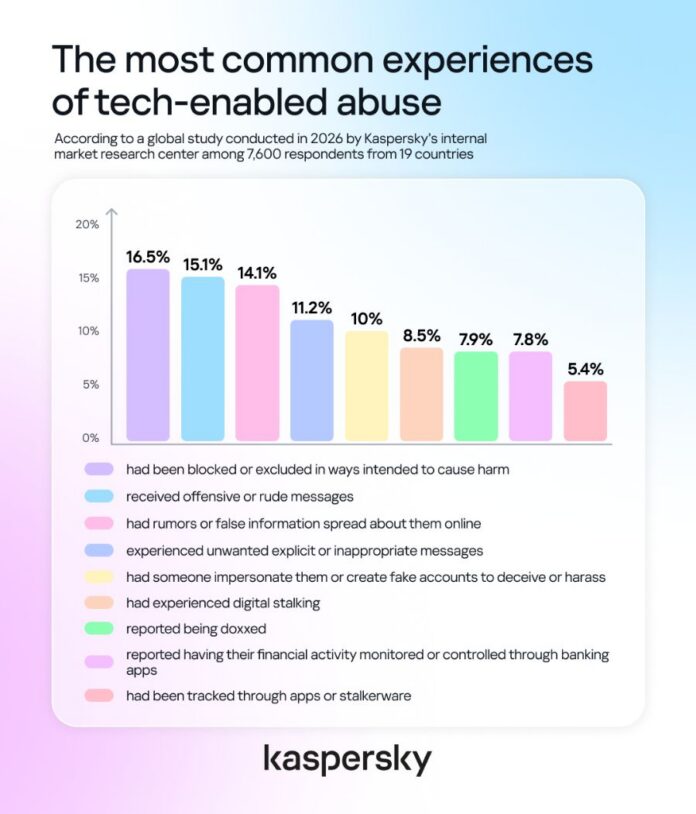
The most commonly reported experience was being blocked or excluded in a way intended to cause harm, affecting 16.7 percent of respondents. Another 15.1 percent reported receiving offensive or rude messages.
Digital stalking and doxxing remain concerns
The study found that 8.5 percent of respondents had experienced digital stalking, while 5.4 percent reported being victims of doxxing, where personal information is publicly exposed without consent.
Kaspersky’s Digital Footprint Intelligence researchers also identified a growing ecosystem of doxxing services being offered on dark web forums, with prices ranging from USD50 to USD4,000. Researchers likewise observed advanced surveillance tools capable of tracking individuals and extracting personal data.
The continuing threat of stalkerware

One of the most concerning forms of tech-enabled abuse is stalkerware. These applications allow someone to secretly monitor another person’s device, collecting information such as location data, messages, photos, call logs, browsing activity, and other sensitive information.
According to Kaspersky, more than 34,000 users were affected by stalkerware between 2024 and 2025. Over the past five years, the company has identified more than 127,000 affected users worldwide and discovered 33 previously unseen stalkerware families.
Users affected by stalkerware were identified in more than 160 countries, with Russia, Brazil, and India remaining among the most affected locations.
Industry collaboration and education
The report highlights the importance of greater awareness and cooperation among technology companies, researchers, educators, non-government organizations, and law enforcement agencies.
Kaspersky is a co-founder of the Coalition Against Stalkerware, an international initiative that brings together stakeholders working to combat cyberstalking and support victims of online abuse.
The company is also participating in the international Tech Abuse Conference hosted by University College London’s Gender and Tech Research Lab, where experts will conduct workshops focused on identifying stalkerware and understanding how such threats operate.
Protecting yourself against stalkerware
Security experts recommend paying attention to warning signs such as unusual battery drain, unexplained data consumption, unfamiliar applications, or unauthorized changes to device settings. Users are also encouraged to protect accounts with strong passwords and seek support from trusted organizations if they suspect they are being monitored.
Experts further advise against immediately removing suspected stalkerware, as doing so could alert an abuser and potentially escalate a dangerous situation. Instead, individuals should seek guidance using a device they know is safe and uncompromised.