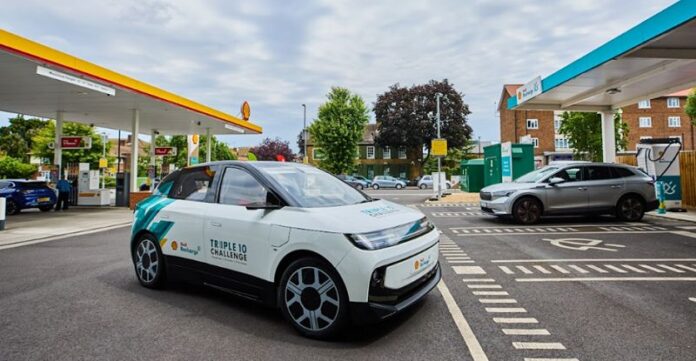

Shell has unveiled the Triple 10 Challenge concept car, a road-ready electric vehicle developed to demonstrate how improved thermal management could support faster charging, better efficiency, and lower lifecycle emissions without relying on increasingly large batteries.
The compact EV was co-engineered with several automotive technology partners and built around a simplified cooling architecture using Shell Recharge thermal fluid.
Shell says the concept was designed around three targets: charging in under 10 minutes, achieving an energy efficiency of 10km/kWh, and limiting its estimated lifecycle carbon footprint to around 10 tonnes of carbon dioxide equivalent.
Three targets for electric vehicle efficiency
The Triple 10 Challenge takes its name from its three principal performance goals:
- Charge faster: complete a rapid charge in under 10 minutes
- Go further: achieve an efficiency rate of 10km/kWh
- Drive cleaner: limit estimated lifecycle emissions to approximately 10 tonnes of CO2e
Shell presents the vehicle as an alternative approach to improving EV performance. Rather than increasing battery capacity, the project focuses on reducing weight, simplifying the cooling system, and managing heat more efficiently across the battery and powertrain.
The company says the vehicle is the first road-ready concept to demonstrate a simplified single-circuit cooling architecture capable of managing the thermal load of the complete electric powertrain during high-speed charging under real-world conditions.
“With the Triple 10 Challenge concept car, we have unlocked the potential for faster charging, lighter systems and improved lifecycle efficiency by using our advanced thermal fluids,” said Cara Tredget, vice president for mobility and lubricants technology at Shell.
“Together with our co-engineering partners, we are proud to develop alternative options for sustainable EV development leveraging technologies that are available today and are scalable to support customers into the future.”
Charging in under 10 minutes
Shell says the Triple 10 Challenge vehicle can charge its battery from 10% to 80% in nine minutes and 54 seconds while maintaining thermal stability and battery life.
The test used a 175kW charger rather than an ultra-fast charger rated above 300kW. Shell notes that chargers exceeding 300kW remain less common across public charging networks.
At 175kW, the concept vehicle is claimed to add approximately 24km of range per minute. Shell compares this with an average of around 13km per minute for typical battery electric vehicles using the same charging output, representing close to 90% more range added per minute.
These results are manufacturer-supplied test figures and should not be treated as independently verified production-vehicle performance.
Targeting 10km/kWh efficiency
The Triple 10 Challenge was designed to achieve an energy efficiency rate of 10km/kWh using a smaller and lighter battery system.
Shell says this represents an improvement of more than 30% in overall energy efficiency compared with many current-generation electric vehicles.
The company attributes the improvement to lower vehicle mass, a more compact battery pack, and the use of thermal fluid that directly cools the battery, motor, and power electronics.
Actual efficiency would depend on vehicle specifications, driving conditions, testing procedures, climate, and final production configuration. Shell has not announced plans to manufacture or sell the concept as a consumer vehicle.
Immersive cooling replaces conventional fluid circuits
The core technology behind the Triple 10 Challenge is Shell Recharge thermal fluid.
Conventional electric vehicle cooling systems commonly use a water-glycol mixture circulated through pipes and cooling plates. In Shell’s concept, a dielectric fluid directly surrounds or immerses heat-generating battery and powertrain components.
Because the fluid does not conduct electricity, it can directly absorb heat from the battery cells, electric motor, and power electronics.
Shell says this approach allows the vehicle to use a simplified single-circuit cooling system. Eliminating some of the piping and supporting hardware found in conventional systems can reduce weight, free up space, and improve thermal control during rapid charging.
The concept was unveiled at HORIBA MIRA’s proving ground in the United Kingdom, where its thermal system underwent vehicle integration, testing, and validation.
Smaller battery pack and lower estimated cost
Shell says the compact battery design uses fewer modules and a simplified housing enabled by the immersive cooling system.
According to the company, these changes could reduce overall battery-pack cost by approximately 25% compared with a conventional electric vehicle battery.
The estimate applies to the concept’s particular architecture and has not been demonstrated through commercial production. Manufacturing volume, battery chemistry, materials, supply chains, safety certification, and regional costs would all affect the economics of a production version.
The company has not disclosed the concept vehicle’s battery capacity, driving range, motor output, dimensions, weight, or complete charging curve.
Estimated lifecycle emissions
Shell estimates that the Triple 10 Challenge concept has a lifecycle carbon footprint of approximately 10 tonnes of CO2e.
The calculation assumes a lightweight design, optimized battery capacity, low-carbon and recyclable materials, and the use of 100% renewable electricity for charging.
Shell says this could represent around a 50% reduction in lifecycle emissions compared with typical battery electric vehicles in the European market.
Because the estimate depends on assumptions about materials, manufacturing, energy sources, vehicle use, and end-of-life treatment, it should be read as a company projection rather than an independently verified lifecycle assessment.
Technology partners support development
Shell worked with RML, Empel Systems, and HORIBA MIRA to develop and validate the vehicle.
RML led the battery-pack architecture and vehicle integration. Its design used Shell’s dielectric fluid to reduce the pipes and associated hardware required by traditional water-glycol systems.
Empel Systems developed the electric motors and drive units. The company used the single-circuit cooling system to reduce motor size while maintaining the power density required for the concept’s efficiency target.
HORIBA MIRA handled vehicle integration, testing, and validation. Its Vehicle Thermal and Electrical Optimisation System was used to test the cooling architecture under simulated extreme weather conditions and assess its compatibility with conventional radiators.
Shell consolidates EV services under Shell Recharge
Alongside the concept-car unveiling, Shell announced that it is bringing its EV charging, thermal fluids, and battery-related solutions together under the Shell Recharge brand.
As part of this consolidation, the Shell EV-Plus brand will be retired.
The move positions Shell Recharge as a broader end-to-end electric mobility offering for business and consumer customers, extending beyond public and home charging into thermal management and battery solutions.
Building on earlier efficiency projects
The Triple 10 Challenge follows several earlier Shell projects focused on vehicle efficiency.
These include Project M, an ultra-efficient city-car concept introduced in 2016, and the Shell Starship program, which has explored fuel efficiency in heavy-duty commercial transport since 2018.
Shell has also used immersive thermal cooling in a hybrid battery developed for a Starship truck with Chinese commercial vehicle manufacturer FAW.
The company’s broader efficiency programs include the Shell Eco-marathon, where student teams design and test energy-efficient vehicles.
The Triple 10 Challenge extends that work into compact electric vehicles, demonstrating how thermal management could influence charging speed, battery size, vehicle weight, efficiency, and lifecycle emissions.
In Summary
Shell’s Triple 10 Challenge is a road-ready electric concept developed around three targets: charging in under 10 minutes, achieving 10km/kWh energy efficiency, and limiting its estimated lifecycle carbon footprint to approximately 10 tonnes of CO2e.
Its key technology is a dielectric Shell Recharge thermal fluid that directly cools the battery, electric motor, and power electronics through a simplified single-circuit architecture. Shell says the system allows the car to charge from 10% to 80% in nine minutes and 54 seconds using a 175kW charger.
The vehicle remains a proof of concept. Shell has not announced production plans, pricing, battery capacity, driving range, motor output, or availability.