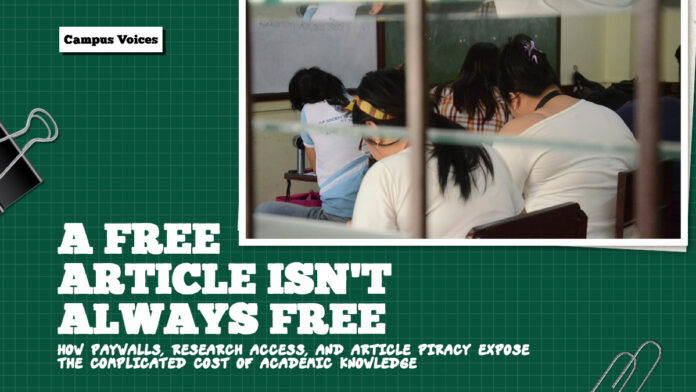

How paywalls, research access, and article piracy expose the complicated cost of academic knowledge
For Biology students, scientific articles are not optional. They are part of laboratory reports, research papers, literature reviews, and countless assignments. We search for studies, skim abstracts, and finally find the article we need, only to discover that it is behind a paywall.
Then comes the familiar thought: “There has to be a free way to get this.”
For some students, that search may lead to unauthorized academic piracy platforms such as Sci-Hub. The appeal is understandable: when deadlines are approaching, an immediate alternative can seem easier than navigating another database. But the issue is bigger than why students use these platforms. It is also about the access gap that makes them attractive in the first place.
Research has documented both the demand for easier access and the risks surrounding academic piracy. Hoy (2017) noted that the high cost of journal articles has driven researchers toward pirate article sites and warned that articles on Sci-Hub have often been obtained using stolen credentials. A separate account by Russell and Sanchez (2016) described a phishing incident in which university users were directed to a fake library login page. Compromised credentials were then used to access licensed academic content, showing how an access problem can become a university cybersecurity problem.
That distinction is important. The risk is not that every visit to an unauthorized platform automatically steals a student’s password. Rather, academic piracy has been connected to compromised credentials and unauthorized access, while suspicious websites and downloads can create additional security risks. Students should avoid entering university credentials into untrusted pages and be cautious about downloads and redirects.
For a Biology student, one compromised account can affect more than one assignment. University email, cloud storage, learning platforms, class files, and research materials may all be connected. What begins as a search for one article can therefore have consequences beyond the article itself.
BUT WHO IS RESPONSIBLE?
It is easy to say, “Students should just use legitimate sources.” Students do have a responsibility to protect their accounts and respect academic and copyright rules, but responsibility does not end with the student.
Universities, libraries, publishers, and research organizations also shape the choices available to students. If legitimate access is limited, students may look elsewhere. Rossello and Martinelli (2024), in a study of 2,849 academics across 30 institutions in six European countries, found that perceptions of academic-value violations were associated with Sci-Hub use even after accounting for other motivations, including lack of journal access. Their findings point to the need to consider the broader academic environment rather than treating piracy only as an individual decision.
The Philippine context makes this conversation more concrete. Students are not without legitimate options. Philippine eLib, a national digital library initiative, provides access to a union catalog and full-text materials, with its site stating that full-text content is available through open access. The Philippine Journal of Science, published by the Department of Science and Technology, is an open-access, peer-reviewed journal covering natural sciences, engineering, mathematics, and social sciences.
SEARCA also provides free downloadable publications, including research, monographs, and other academic materials, while Haribon Foundation maintains free research and biodiversity materials, including studies, reports, and field resources. These resources do not replace every international journal subscription, but they show that legitimate channels already exist and can be strengthened.
ACCESS IS PART OF THE SOLUTION
If we want students to avoid risky or unauthorized sources, simply telling them what not to use is not enough. Universities can improve library support, expand database access where possible, promote open-access materials, and teach students how to locate legitimate versions of papers. Libraries can help students navigate Philippine eLib, institutional repositories, and other trusted resources, while publishers and research organizations can continue developing models that make scholarly literature more accessible.
Students, meanwhile, can do their part by using institutional resources, checking unfamiliar websites carefully, avoiding suspicious downloads, and never entering university credentials into pages they cannot verify.
Academic piracy is therefore not just a story about students making bad choices. It is a story about what happens when the demand for knowledge meets barriers to access, and when alternative routes may carry risks.
As Biology students, we learn to examine systems, not just isolated events. The same approach applies here. If we want safer research practices, we need to look at the whole system: students, universities, libraries, publishers, and the digital spaces connecting them.
Scientific knowledge should be accessible enough to support learning without forcing students to trade convenience for security. Because sometimes, the article costs nothing, but the risk does.
References
- Hoy, M. B. (2017). “Sci-Hub: What librarians should know and do about article piracy.” Medical Reference Services Quarterly, 36(1), 73–78.
- Russell, C., & Sanchez, E. (2016). “Sci-Hub unmasked: Piracy, information policy, and your library.” College & Research Libraries News, 77(3), 122–125.
- Rossello, G., & Martinelli, A. (2024). “Breach of academic values and misconduct: The case of Sci-Hub.” Scientometrics, 129, 5227–5263.
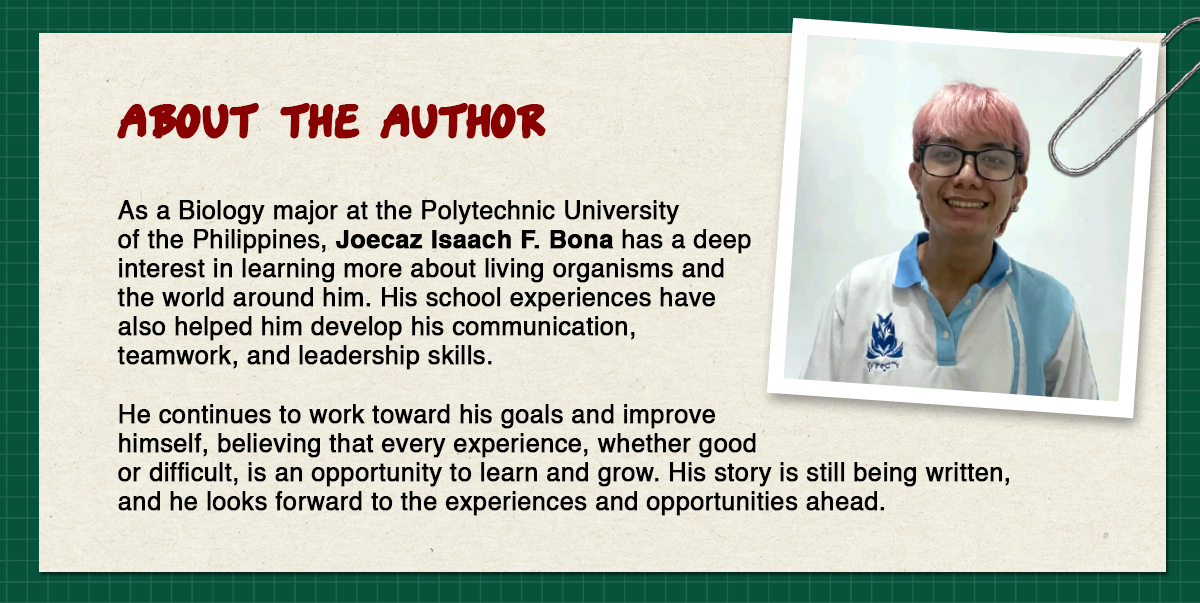
Words by Joecaz Isaach F. Bona
Photo by Nash Gabriel
Also published in GADGETS MAGAZINE Volume 27 Issue No. 3