
A new white paper sets out the business case for industrial decarbonization, from efficiency gains to resilience and new revenue
A new white paper, Decarbonizing Manufacturing and Supply Chains for Growth: Guide for C-suite Executives, published by the World Economic Forum in collaboration with Tata Consultancy Services, sets out the business case for industrial decarbonization. It shows how decarbonization can improve efficiency, strengthen resilience, and create opportunities for growth and competitive advantage. Drawing on industry insights and real-world case studies, the report gives senior executives a practical approach for turning decarbonization ambition into measurable business value.
DOES DECARBONIZATION STILL MATTER FOR INDUSTRY?
Amid geopolitical fragmentation, economic pressure, and uncertain policies, some question whether decarbonization remains a priority for manufacturers and supply chain leaders operating on tight margins with complex global footprints. The report answers that decarbonization is not a trade-off against growth and competitiveness; the question is how to decarbonize in ways that create measurable business value. As evidence, it points to the S&P 500 Paris-aligned benchmark, which has posted annualized returns of 16 percent since its launch in 2020.
A GAP BETWEEN TARGETS AND PLANS
The green economy now exceeds USD5 trillion annually and is growing at twice the pace of conventional revenues. Yet while two-thirds of the world’s largest publicly listed companies have net-zero targets, only 8 percent have decarbonization plans, and just 4 percent have allocated working capital to deliver them. The report calls this disconnect a sign that many companies still treat sustainability as a compliance task and not an integrated business transformation.
THREE SOURCES OF BUSINESS VALUE
The report draws on consultations with more than 50 industry leaders, academic experts, and innovators across 13 industrial sectors. It identifies three sources of business value from decarbonization:
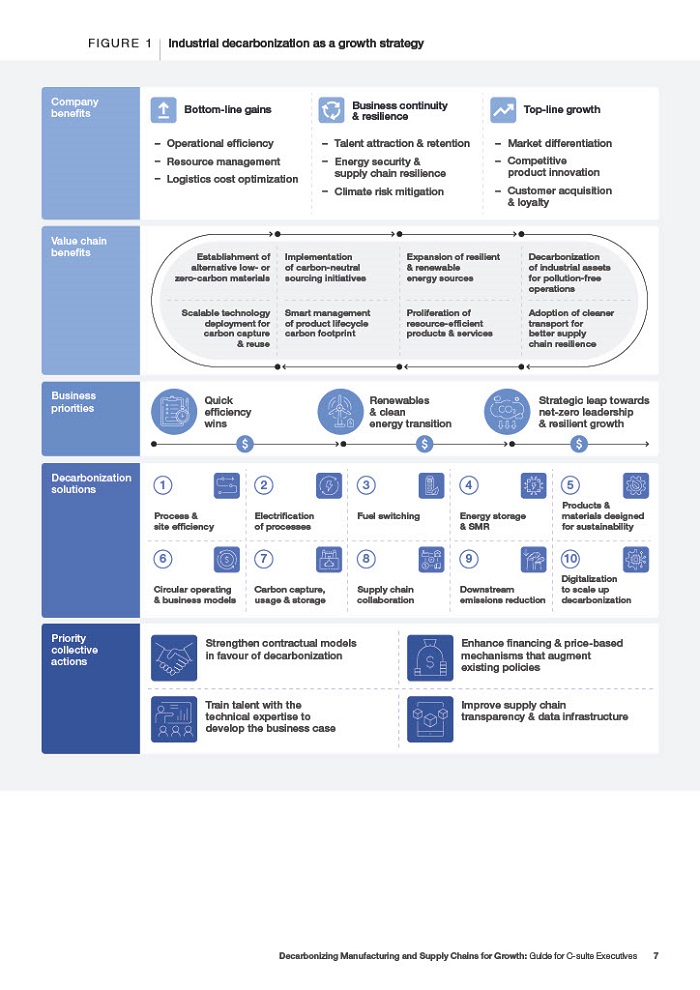
- Bottom-line gains: Operational efficiency and smarter resource management
- Business continuity and resilience: Energy security, supply chain resilience, climate risk management, and the ability to attract talent
- Top-line growth: Market differentiation, product innovation, and durable customer loyalty
TEN SOLUTIONS, COMPARED
The report compares 10 practical decarbonization solutions across business value, greenhouse gas reduction potential, and implementation complexity, to help executives prioritize where to act and invest. They are:
- Process and site efficiency
- Electrification of industrial processes
- Fuel switching
- Energy storage and small modular reactors (SMRs)
- Designing products and materials for sustainability
- Circular operating and business models
- Carbon capture, utilization, and storage (CCUS)
- Supply chain collaboration
- Downstream (use phase) emissions reduction
- Digitalization to scale up decarbonization
Process and site efficiency is often the preferred starting point. The report says efficiency measures can reduce up to 40 percent of energy-related emissions, with attractive returns on investment, and notes that sites in the Forum’s Global Lighthouse Network have achieved over 50 percent productivity improvements, more than 80 percent defect reductions, and around 30 percent CO2 reductions.
A THREE-LEVEL APPROACH
The report’s phased approach helps manufacturers move through three levels of priorities:
- Quick efficiency wins: Energy and material efficiency, asset optimization, and process enhancements that deliver benefits within one to two years and free up capital for later investments.
- Renewables and clean energy transition: Renewable energy adoption, electrification of industrial assets, and electric mobility, typically realized over three to five years, reducing exposure to energy price volatility.
- Net-zero leadership and resilient growth: Transforming manufacturing processes through product design and process innovation, integrating clean energy at scale, adopting circularity, and redesigning upstream and downstream value chains with partners.
Financial gains from early efficiency measures can be reinvested at later stages, easing capital constraints and reducing scaling risks.
CASE STUDIES
Six real-world case studies, from Unilever, Schneider Electric, DP World, Western Digital, Koç Holding, and Foxconn Industrial Internet, show how decarbonization can translate into business value:
- Foxconn Industrial Internet’s AI-powered eco-design platform delivered a 107 percent ROI, enables 80 percent eco-design product coverage, and helps small and medium-sized suppliers decarbonize.
- At Koç Holding’s Beko, the Eskişehir refrigerator factory recorded a 43 percent increase in production capacity, a 17 percent reduction in transformation costs, and a 20 percent reduction in customer complaints.
- Products and services with demonstrated environmental benefits accounted for 75 percent of Schneider Electric’s total revenues in 2025.
- Western Digital repurposes retired data center storage devices and captures 90 percent of rare earth elements.
- DP World is running a carbon insetting program to track and expand lower-carbon short-sea shipping.
- Unilever is cutting packaging emissions through recycled and refillable designs.
FOUR ACTIONS TO SCALE UP
The report says industrial decarbonization can ramp up when it is supported by commercially viable business cases, cross-industry collaboration, and enabling policy frameworks. Based on consultations with more than 50 senior industry champions, it identifies four collective actions: strengthening contractual models in favor of decarbonization, enhancing financing and price-based mechanisms that augment existing policies, improving supply chain transparency and data infrastructure, and training talent with the technical expertise to develop the business case.
A PRACTICAL PATHWAY FOR SENIOR LEADERS

“Many manufacturers still face a conundrum: how to decarbonize complex industrial value chains while protecting margins and sustaining growth. We need to reframe decarbonization as a value-creation strategy that can strengthen operational efficiency, reduce exposure to energy and supply risks, and unlock new revenue opportunities. This report gives senior leaders a practical pathway to navigate implementation complexity and turn decarbonization ambition into measurable business outcomes,” said Anupam Singhal, president for manufacturing at Tata Consultancy Services.
ABOUT THE RESEARCH
The white paper was developed by the World Economic Forum’s Centre for Advanced Manufacturing and Supply Chains in collaboration with Tata Consultancy Services. Its findings draw on more than 50 consultations with global manufacturers, supply chain leaders, academics, civil society, and policymakers across 13 industrial sectors.