
Digital transfers are seen as the fastest way to move money, while stablecoins draw interest but face a trust gap
Visa has commissioned the Money Travels: 2026 Digital Remittances Adoption report, which tracks new consumer trends in money movement and underscores the role digital remittances play in supporting Filipino households. Covering more than 45,000 remittance senders and receivers across 20 markets, including the Philippines, the report finds growing interest in stablecoins as trust and speed shape consumer expectations of digital remittances.
Key findings for the Philippines:
- 45 percent of Filipino respondents received money from overseas in the last 12 months.
- Mobile wallets are seen as the fastest transfer method, with 44 percent citing instant access to funds.
- 79 percent want more education on how stablecoins work.
PHILIPPINES IS THE TOP RECEIVER-LED MARKET
With 72 percent of Filipinos sending or receiving money multiple times a year and about 35 percent doing so once a month, the Philippines has one of the highest remittance activity footprints in the region. It is the top receiver-led market among key markets surveyed, including Australia, Mainland China, Japan, India, and Singapore, with 45 percent of Filipino respondents having received money from overseas in the last 12 months.
Filipinos cite both economic and cultural reasons for remittances. Support for essentials (34 percent) and a family or cultural obligation to provide or receive support (33 percent) are the top reasons, the highest among the six Asia Pacific markets surveyed. Another 30 percent cite gifts for holidays or special occasions, the second highest after Australia.
SPEED AND TRUST SHAPE REMITTANCE BEHAVIOR
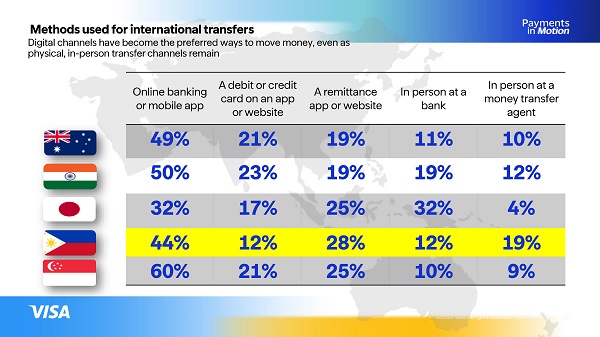
Digital transfers are seen as the fastest remittance options. Mobile wallets rank first for speed, with 44 percent of respondents saying they access funds instantly through this channel. Digital transfers direct to a bank account come second (31 percent), followed by debit or credit cards on apps or websites (20 percent). Only 18 percent say in-person transfers at a bank, money transfer agent, or store enable instant fund access.
Banking hours are also a pain point: 27 percent cite difficulty in transacting outside normal banking hours, and only 19 percent of Filipinos make in-person transactions at physical money transfer agents or stores.
INTEREST IN STABLECOINS GROWS, BUT TRUST HAS TO FOLLOW
For the first time, the study examined consumer awareness, perceptions, and adoption intent toward stablecoins. It finds that education and confidence will be key to broader adoption amid growing concerns about scams, fraud, and AI-enabled threats.
While 42 percent of Filipino respondents have some awareness of stablecoins, trust in stablecoin transfers is lower at 38 percent, compared with cash remittances (81 percent) and digital remittances (79 percent). Some 20 percent say they already have some knowledge of stablecoins.
This trust gap points to room for expanding consumer awareness, with 79 percent of Filipinos saying they want more education on stablecoins and how they work. The government (70 percent) and global payment networks like Visa (68 percent) are the most trusted entities for handling digital currencies.
“Visa continues to be at the forefront of shaping global money movement, and enabling faster, more secure, and seamless money transfers will help build trust in emerging digital remittance methods and technologies such as stablecoins. With the Philippines becoming one of the most dynamic remittance markets in the region, we will continue to work with regulators as well as our bank and fintech partners to make money movement solutions more responsive to the evolving needs of Filipino consumers across the globe,” said Jeffrey Navarro, country manager for Visa Philippines.
To learn more about the trends shaping cross-border money movement across Asia Pacific, explore the Money Travels 2026 findings.