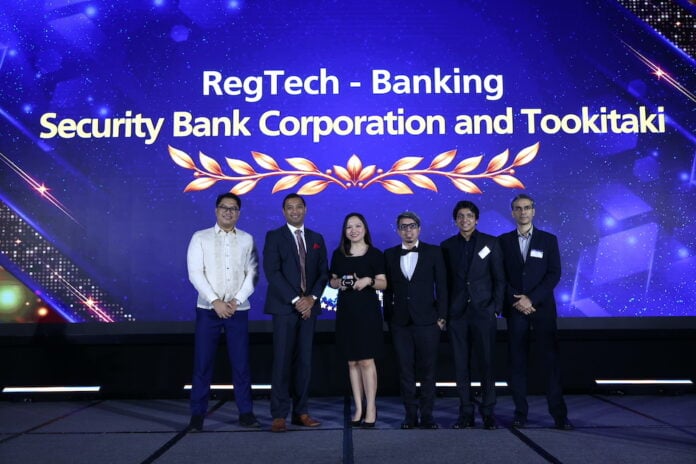

Security Bank Corporation has expanded its sanctions-screening coverage tenfold after modernizing its compliance infrastructure with Tookitaki’s FinCense Screening platform.
The implementation also extended screening to 100% of related contacts and significantly increased monthly confirmed matches, according to the companies. The project was named Best Technology Implementation by a Retail Bank at the Asian Technology Excellence Awards 2026 on September 17.
MOVING BEYOND EXACT-NAME MATCHING
Traditional sanctions screening often relies heavily on matching customer names against sanctions and watchlists. That process becomes more difficult when names appear with variations in spelling, sequence, transliteration, aliases, or other differences.
The challenge can be particularly relevant in the Philippines, where surnames may have Spanish, Chinese, or local origins, while a mother’s maiden surname commonly appears as part of a person’s full name.
FinCense Screening is designed to account for these variations through AI-based matching across spelling, name order, phonetics, languages, and scripts.
Reverse screening can also help identify potential exposure when watchlists change, while explainable risk scoring gives investigators additional context for understanding and prioritizing alerts.
SCREENING ACROSS THE CUSTOMER LIFECYCLE
Security Bank and Tookitaki implemented the platform as part of a broader lifecycle approach covering customers and related parties.
“This collaboration provided Security Bank with a scalable screening platform that enhances screening coverage, improves the identification of genuine matches, and supports transparent, auditable decision-making,” said Daniel Ang, head of financial crime compliance at Security Bank.
“The solution is designed to help meet evolving regulatory expectations while supporting long-term business growth.”
The platform was integrated into Security Bank’s existing screening operations through collaboration between the bank’s compliance and technology teams and Tookitaki.
WHY SANCTIONS SCREENING MATTERS
Sanctions screening is an important part of financial institutions’ anti-financial crime controls and also supports correspondent banking relationships used for cross-border transactions.
The issue carries particular significance for the Philippines, which received a record US$35.63 billion in cash remittances from overseas Filipino workers in 2025, according to figures cited in the release.
The Financial Action Task Force removed the Philippines from its grey list of jurisdictions under increased monitoring in February 2025. The country’s next mutual evaluation by the Asia/Pacific Group on Money Laundering is scheduled to begin in 2027.
Against that backdrop, financial institutions are under pressure not only to maintain compliance systems but also to demonstrate that those controls work effectively in practice.
AI FOCUSES ON DETECTION QUALITY
For Tookitaki, the value of AI in compliance lies not simply in processing alerts faster but in improving what financial institutions can detect.
“AI in compliance should be judged by whether it improves what a bank can detect,” said Abhishek Chatterjee, founder and chairman of the board at Tookitaki.
“Clearing alerts faster helps, but it is not the real test. Security Bank’s results show that broader matching capabilities can identify genuine risk beyond the reach of exact-name matching alone, while giving investigators clear, explainable reasons for every alert.”
Tookitaki CEO Isabel Ridad added that the Security Bank implementation provides measurable results from a regulated Philippine banking environment.
RESPONDING TO MORE COMPLEX WATCHLIST DATA
Financial institutions also have to contend with sanctions lists containing aliases and alternative spellings.
Since September 2024, the US Treasury has sanctioned more than 200 individuals and companies associated with scam and money-laundering networks in Southeast Asia. That includes 146 targets linked to Cambodia’s Prince Group in October 2025.
Such designations can contain multiple aliases and spelling variations, increasing the need for screening systems capable of looking beyond exact character-by-character matches.
SECURITY BANK PLANS FURTHER SCREENING ENHANCEMENTS
Security Bank plans to continue optimizing its screening framework, including trigger-based screening and broader coverage across customers and related parties.
The bank is also assessing the potential use of Tookitaki FinCense Transaction Screening, subject to internal governance and approval processes.
Tookitaki currently works with banks and financial institutions across Asia Pacific, including UOB, Fubon Bank, AEON Bank, GCash, Maya, and Tyro Payments.
More information about the technology is available through the Tookitaki website, while information about the bank is available through the Security Bank website.