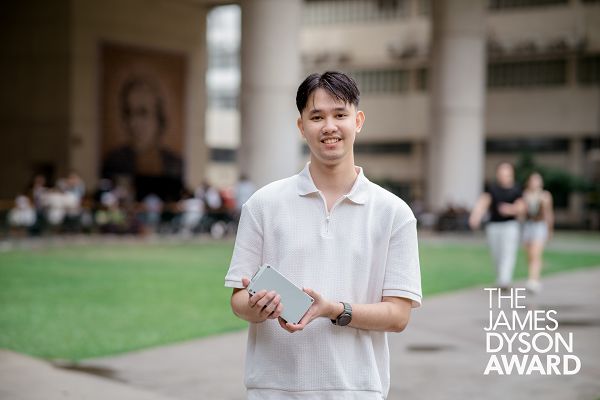

Six years after the last Philippine win, a De La Salle University graduate brings the Global Sustainability Award home with a sensor designed to reveal hidden structural damage after earthquakes
Young Filipino structural engineer and De La Salle University graduate Aldrei Ong has been named the 2026 Global Sustainability Winner of the James Dyson Award for Sentinel, a low-cost building damage sensor designed to reveal hidden structural damage after earthquakes. He will receive PHP2,390,230 to further develop the invention.
The recognition is especially significant in the earthquake-prone Philippines, where the danger does not end when the shaking stops. Families, students, workers, and patients may still have to wait for engineers to determine whether homes, schools, offices, hospitals, and places of worship are safe to enter. A magnitude 7.2 earthquake could cause an estimated 48,000 deaths and USD48 billion in economic losses across Greater Metro Manila, according to the World Bank.
THE PROBLEM WITH HIDDEN DAMAGE
Earthquakes can cause cracks and internal damage to concrete structures that are not immediately visible, so determining whether a building is safe often relies on visual inspections and specialist testing. After a major earthquake, when many buildings may need to be assessed at once, this process can be slow, costly, and disruptive. Buildings commonly have systems such as smoke detectors and fire alarms to monitor other safety risks, but structural damage is still often identified through periodic inspection and not continuous monitoring.
THE WINNING SOLUTION: SENTINEL
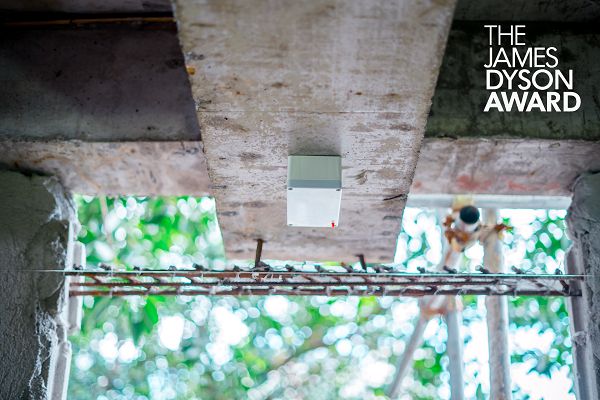
Ong is helping to prevent building collapses after earthquakes. Sentinel turns a standard concrete spacer block, a component already used to hold reinforcing steel in position during construction, into a low-cost sensor capable of detecting hidden cracks and internal damage.
Sentinel is made from self-sensing concrete containing conductive materials that allow electricity to pass through the block. When the concrete cracks or is damaged, its electrical resistance changes, giving a measurable indication of potential damage. Embedded electrodes connect each block to a small electronic module, which monitors these changes against the sensor’s original reading. If a significant change is detected, the data is sent wirelessly to an online dashboard, allowing engineers to remotely monitor a building’s condition over time.
“After an earthquake, serious damage inside a concrete building can be invisible, and potentially fatal. Aldrei’s Sentinel cleverly turns a component already used in construction into a low-cost sensor that detects cracks and gives early warning of damage. It’s an ingenious solution that could catch problems before they become costly and, more importantly, stop people living or working in buildings at risk of collapse,” said James Dyson, founder of Dyson.
On winning the award, Ong said: “Becoming the Global Sustainability Winner of the James Dyson Award means a great deal to me, not only because of the impact Sentinel could have, but because it affirms what persistence, curiosity and a willingness to keep improving can achieve. The journey was full of doubt, frustration and failure, but I wouldn’t have it any other way. This recognition gives me the confidence to keep pushing Sentinel forward, with the ambition of making buildings safer and helping people better understand the structures they depend on.”
Dr. Bernardo Lejano, professor of structural engineering in the Department of Civil Engineering, added: “I am very glad that Aldrei continued his research into self-sensing concrete beyond his master’s degree, developing it into an innovative and sustainable structural health monitoring system that could save lives and protect property. I believe it won’t be long before Sentinel becomes a mandatory component of reinforced concrete structures, enabling quicker assessments of structural safety. I hope Aldrei’s achievement will inspire many young engineers to think outside the box.”
BUILT FOR AFFORDABILITY AND SCALE
Sentinel has been designed with affordability in mind, making it easier to install at scale. Because it transforms a component already used in reinforced concrete construction, it can be incorporated into buildings as they are built without adding a separate structural element.
Ong developed Sentinel through master’s research into self-sensing concrete. Over more than a year, he mixed, cured, and tested more than 125 concrete samples to refine the material and understand how its electrical resistance responds to loading and cracking.
Sentinel sensors have now been embedded within a building in the Philippines for real-world monitoring. After winning the award, Ong plans to keep validating the technology, replace its hand-soldered electronics with a custom printed circuit board, and develop versions that could be fitted to existing buildings.
THE GLOBAL MEDICAL WINNER: RUMBLE RIMS
Sentinel is joined by Rumble Rims as the 2026 Global Medical Winner. Developed by Harvard University students Radhika Saran, Cleo Pontone, and Sophia DeVito, Rumble Rims is a low-cost infrared eye-tracking headset designed to bring objective concussion screening to the sidelines and help inform safer return-to-play decisions.
“This year’s global winners, Sentinel and Rumble Rims, tackle serious dangers to life and health with remarkably simple ideas. They could save lives, and that kind of bold thinking is exactly what I hoped to encourage when I created the James Dyson Award 21 years ago. Both are very worthy winners,” Dyson said.
Concussion is a traumatic brain injury that can be difficult to recognize on the sidelines because symptoms vary and may take up to 72 hours to develop, according to the FIFA and World Health Organization Suspect and Protect campaign. Continuing to play can prolong recovery and increase the risk of further injury, while objective assessment technology can be expensive and clinic-based.
Rumble Rims aims to bridge this gap. The headset uses infrared cameras to measure how an athlete’s eyes follow, fixate, and move during a short 60-second test. Its mobile display provides real-time guidance to help inform whether an athlete should be removed from play and referred for professional medical assessment. It is intended as a screening tool and not a diagnostic one, with return-to-play decisions remaining under the direction of a qualified healthcare professional.
“All too often, we hear of those having accidents involving head injuries, particularly amongst athletes, and suffering the consequences later in life. Yet spotting concussion is complex, requiring specialist equipment and hospital expertise, so screening isn’t always done when it should be. Cleo, Radhika and Sophia have found a new way to bring objective screening to the sidelines, where the critical decisions are made. It could help prevent the lasting brain injuries that affect so many sportsmen and women,” Dyson said.
“The recognition from the James Dyson Award validates our belief that we don’t have to accept problems as they stand today. Concussions in youth sports have become something we treat as routine, despite their long-term neurological impact. We can challenge norms like this one and design a more usable, accessible world where technology reaches people when they need it most, not after the damage is done. This award gives us an incredible opportunity to progress towards pilots that could put Rumble Rims on every sideline,” the winners said.
A SECOND PHILIPPINE WIN, SIX YEARS ON
Ong’s win brings the Sustainability Award back to the Philippines six years after fellow Filipino inventor Carvey Ehren Maigue won in 2020 with AuREUS, a system for walls and windows that uses materials derived from upcycled crop waste to absorb stray ultraviolet light and convert it into renewable electricity.
Now in its 21st year, the James Dyson Award received a record 2,294 entries from 28 countries and regions in 2026, the highest number of entries to date.