
In late February 2026, Discord announced it would implement global age verification through facial recognition under the pretext of protecting children. While, on the surface, it shouldn’t be controversial (after all, child online safety is vital to a healthy Internet), the move raised serious questions about how that data should be handled and where it would go. Previously, a third-party vendor of Discord had a data breach in late 2025, exposing millions of users’ personal data. Journalists also uncovered ties to the controversial surveillance company Palantir and its equally controversial founder, Peter Thiel, raising even more questions about their actions. Discord then walked back its announcement, but as anyone knows, this could resurface in the near future.
However, in an Internet age when no one is truly anonymous, and your data is out there for everyone to see, I thought about a different time when you didn’t have to worry about your data ending up in the hands of nefarious individuals—reminiscing about the days of Internet Relay Chat (IRC), which offered all the fun of communication on the Internet without the fear of handing your entire life over to unknown and often malicious parties. Why is IRC so important, and what made it the chat system of choice for the privacy-conscious individual?
We should start by saying that the right to privacy (to be left alone) in an online context is key in an age of interconnectivity. I should also fully disclose that I am a victim of identity theft, so my thoughts on the matter are very biased. The European Union (EU), at the time of this writing, has one of the strongest data privacy laws in the world through the General Data Protection Regulation (GDPR), which is a very complex yet effective way of shielding one’s online privacy.
Finnish IT professional Jarkko “WiZ” Oikannen founded IRC in August 1988, before the age of the commercial Internet, to replace MultiUser Talk (MUT). IRC, like many modern online communication tools, allows one to communicate in groups, one-on-one, and even share files. The original IRC was an extension of the bulletin board systems (BBS), a precursor to today’s Reddit, to allow Usenet-style news discussions. WiZ implemented the chat feature first, with inspiration from Bitnet Relay and assistance from friends Jyrki Kuoppala and Jukka Pihl. IRC initially ran on a single server, tolsun.oulu.fi (.fi being Finland’s top-level domain code).
Kuoppala then encouraged WiZ to ask Oulu University to free up the IRC code so it could be used outside of the university. Once this happened, Kuoppala installed another server so it could become a network. Kuoppala then contacted individuals across Finland to also install their own IRC network, spreading to the United States, and by 1989, there were 40 servers worldwide. By 1990, however, cracks formed within IRC itself, with Anarchy.net, or “A-net,” including a server called eris.berkeley.edu, which was all open, with no passwords, and unlimited connections, an unthinkable thing in today’s online world. The server, EFnet, was eventually Q-lined (quarantined) from IRC, and A-net was eventually disbanded. One important thing to note is that IRC reported on major events despite media blackouts, such as the Gulf War and the 1991 Soviet coup attempt, making it an example of people reporting news on the Internet in its (relative) infancy.
IRC user “Wildthang” undertook another fork effort in 1992, initially meant to test bots but grew into a network for “friends and their friends,” uniting the Canadian, French, and US networks into a network called “The Undernet,” which grew into one of the largest IRC forks in the world, being the first to utilize timestamping and also wanted to reduce bandwidth use, trying to reduce netsplits and takeovers that were common on EFnet. The Undernet itself was hacked in 1994 by users forming DALnet, headed by Alexei “Lefler” Kosut. While DALnet used the Undernet IRC daemon (ircd) server, some were also from EFnet. Brian “Morpher” Smith wrote many of DALnet’s functions, giving users nicknames, control of channels, early memes, and more.
The next split after flame wars (defined as users exchanging angry or abusive messages) and discussions revolving around the development of ircd occurred in 1996, when IRCnet was formed. There was also a clear geographic split: European users formed IRCnet for nick and channel delays, while EFnet users, mostly those from North America, wanted timestamps and less control over what moderators could and couldn’t do, showing a clear split in the formative days of the Internet over North American and European attitudes towards IRC and the Internet in general.
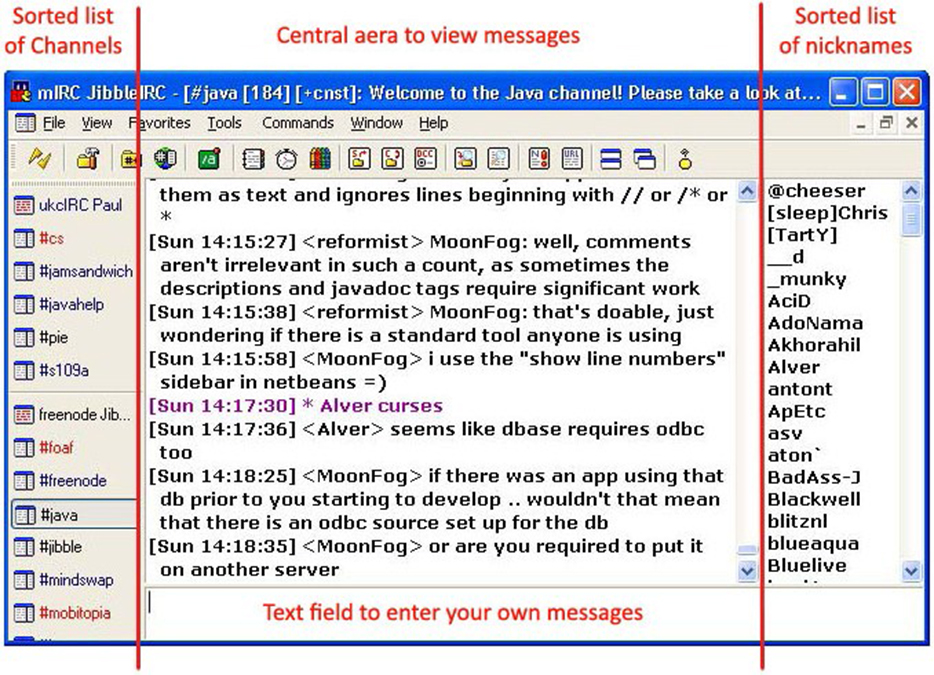
Eventually, Modern IRC, or mIRC, was formed despite the many splits between IRC users, modernizing the protocol in a number of ways. IRC reached 6 million users by 2001 and 10 million by 2005; however, modern social networking and newer platforms resulted in emigration from mIRC, dropping to only 350,000 by 2021. As of 2026, mIRC continues to exist, as well as the “Big Four” IRC networks of EFnet, IRCnet, Undernet, and DALnet. Other networks existed, namely freenode (1995-2021), a network that discussed open source projects, namely Linux, Ubuntu, and the Wikimedia Foundation, which migrated to Libera Chat in 2021.
So this raises yet another question regarding IRC’s role in shaping modern Internet communication: what then, exactly, is IRC’s legacy? The chaos and disagreements in a minimalist atmosphere? Promoting open-source software that anyone can use? Forming many of the foundations that modern Internet communication platforms use today? The answer is all of the above, yet we have unfortunately lost our way when it comes to privacy—whether we bare all for the world to see or move in silence, IRC was a way of connecting with the world without the worries of doxxing that many of us face in today’s era of the Internet.
Words by Jose Alvarez
Also published in GADGETS MAGAZINE Volume 26 Issue No. 8