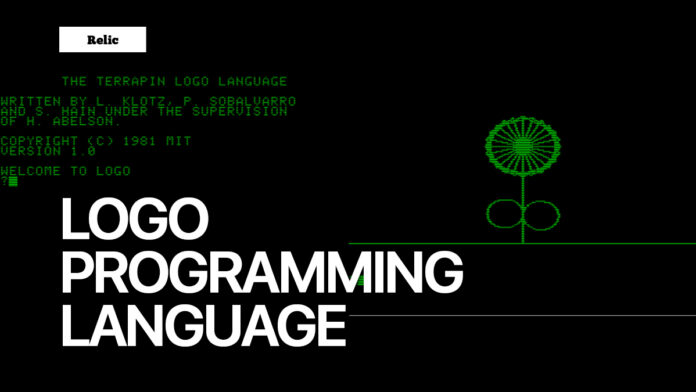

The classroom can be a place to learn anything—math, English, science, reading, history, other languages—the list is practically endless. One popular narrative (until recently) was that people should learn to code to make a good living. While it has been successful for many people, the dynamic has rapidly changed as layoffs have reportedly increased due to the ramp-up of artificial intelligence (AI) in recent years. However, it’s never a bad thing to learn. So, how did one learn to code? My research took me to the Logo programming language. Why was Logo so important to learning, and what made it essential for coding to this day?
Wally Feurzeig, Seymour Papert, and Cynthia Solomon created Logo in 1967 at Bolt, Beranek and Newman (BBN) in Cambridge, Massachusetts. It is a general-purpose programming language known for its turtle graphics, and its movement and drawing commands produce line or vector graphics. The intellectual roots of Logo were in artificial intelligence (AI), mathematical logic, and developmental psychology, placing it at the intersection of technical and functional use and allowing anyone to pick it up and start learning.
Logo was also used to help children think computationally, using Papert’s educational theory about constructionism, or the idea that people can learn best by creating things themselves, a way of learning by doing (think back to science class when you first heated a cup of water to create steam). While created in 1967, Logo did not take off until the 1970s-1980s. Children used Logo on Apple, IBM, and Commodore computers. The first recorded use of Logo at a year-round school was at Muzzey Jr. High in Lexington, Massachusetts, with fifth-graders using the virtual and physical turtles at the Bridge School in the 1970-71 school year.
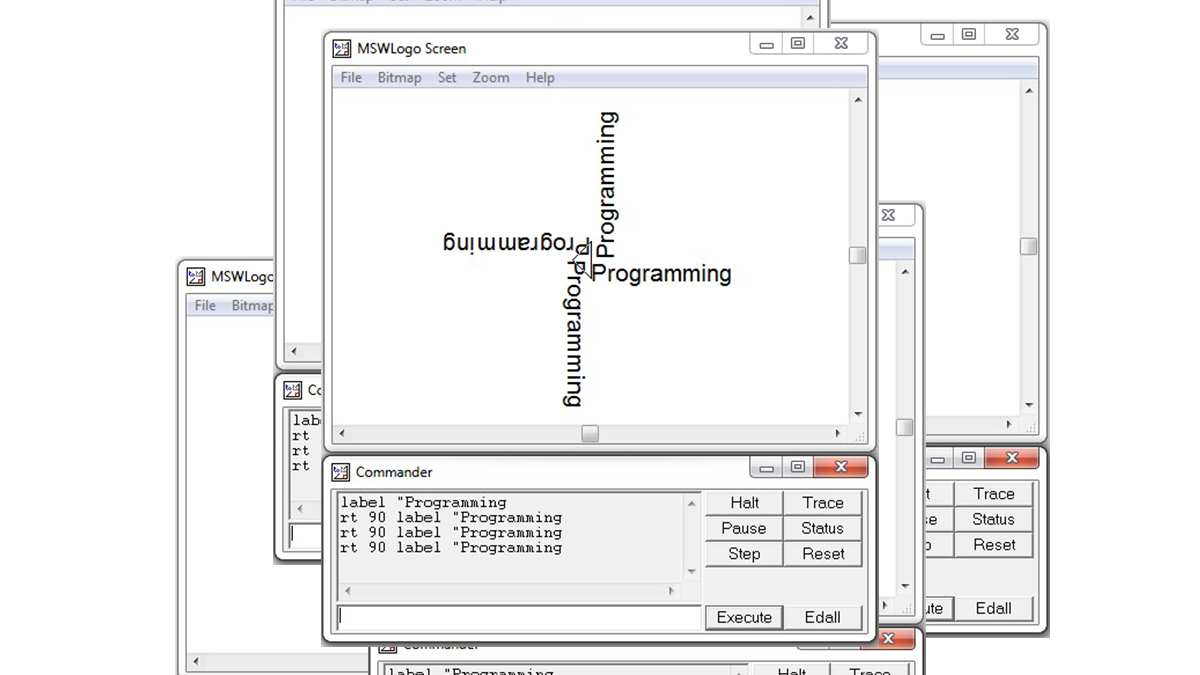
How did Logo work? Logo used turtle geometry to mimic the movement of the actual turtle robot. For example, the command LEFT 90 meant to spin left by 90 degrees. Thanks to modern technology, this could quickly scale to form more complex shapes. What made Logo unique, though, was its focus on teaching students how to think, making programming accessible to younger individuals, using graphics for immediate feedback, and encouraging exploration of the unknown rather than the rote memorization common in schools and other coding languages. Most programming languages focused on business, engineering, or scientific computing, while Logo sought to reach other audiences who may have felt overwhelmed by the complexities of engineering or scientific computing.
Due to its encouragement of exploration and prioritization of critical thinking, Logo had no agreed-upon standard, and many implementations (as many as over 300 as of 2020) existed, such as the implementations of Logo for the aforementioned Apple, IBM, and Commodore: Apple Logo for the Apple II Plus and IIe, IBM Logo with Logo Computer Systems, Inc., and Commodore Logo. It also influenced the Smalltalk programming language and even provided the framework for Boxer, a simplified version of the language based on a literacy model designed for nontechnical users.
What is Logo’s legacy? Logo opened up programming to everyone, not just the smartest people, and encouraged thinking and innovation. It was also a programming language of some popular early PCs. While it is still used today, there are only a few active implementations. On top of its use as a programming language, it is also said to have changed education as a whole, with Papert’s constructionism also influencing project-based learning and educational design, but research as well. One implementation of Logo, NetLogo, has been used for many social behavior models, traffic simulations, ecosystem modeling, and economic experiments. While the classroom Logo is long gone, its influence remains, even almost 60 years later.
Words by Jose Alvarez
Also published in GADGETS MAGAZINE Volume 26 Issue No. 10