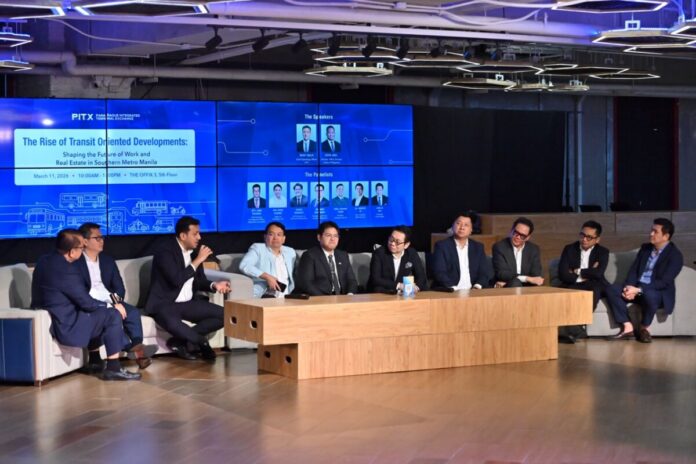

A media forum titled “The Rise of Transit-Oriented Developments: Shaping the Future of Work and Real Estate in Southern Metro Manila” was conducted recently at the Parañaque Integrated Terminal Exchange (PITX).
With 179,000 daily passengers and a rapidly shifting skyline, PITX has officially evolved from a transit stop into the heartbeat of a new economic district. No longer just a gateway for commuters, the country’s first “landport” is now the primary engine driving investment and urban renewal in the south, proving that the solution to Metro Manila’s gridlock lies in building workplaces where the buses stop.
Strategic Decongestion: Solving the EDSA Crisis
PITX chief operating officer Mohit Malhi introduced the terminal as a primary solution to the chronic traffic congestion on EDSA. By serving as a synchronized gateway for provincial and city transport, PITX effectively filters thousands of vehicles before they enter the capital’s saturated main artery.
“Traditionally, office spaces were created as destinations that required further travel after reaching a transport hub. But given current market realities, we are rethinking the workplace,” Malhi stated. “By integrating professional office spaces directly into the terminal, PITX eliminates the need for secondary commutes into the heart of the city, keeping thousands of commuters off interior roads while providing a seamless ‘transit-to-desk’ experience.”
The Parañaque Transformation
The terminal’s presence has fundamentally shifted the economic landscape of the city. This was reaffirmed by Cisette Ricardo, Parañaque City tourism head, who noted:
“PITX has become a magnet for new investment. We are witnessing a surge in developer interest, with more commercial establishments and mixed-use projects rising specifically due to the terminal’s strategic placement and massive daily foot traffic.”
A New Standard for Transit-Oriented Development (TOD)
The forum underscored that PITX is the blueprint for the future of Philippine urban planning. Industry leaders shared insights on how transit-oriented hubs are shaping commerce and real estate:
Johnlu Koa, president of The French Baker: “The massive daily passenger flow offers unlimited brand exposure, allowing retailers to thrive outside traditional shopping malls.”
Kevin Jara, director for office services of Colliers: “Office demand is increasingly centering around transport-connected hubs, making TODs the most resilient assets in the real estate market.”
DOTr director for road and infrastructure Joshua Rodriguez: “The government is shifting its focus toward moving people rather than cars, and PITX serves as the gold standard for efficient mobility.”
VisionArch VP Architect Kenneth Uy: “Designing cities around transit hubs creates healthier, more walkable, and environmentally sustainable urban environments.”
Jaime Raphael Feliciano, Megawide chief business development officer and PITX president: “The ‘transit-centric’ model pioneered at PITX is ready for expansion. We are currently exploring similar integrated developments in Carmona, Baguio, and Lipa to replicate this success across the archipelago.”
Giovanni Tuapin, Internship Crew president: “When we were planning where to locate our operations, we wanted a place that would provide not only the right position for the business but also a better experience for our employees. As our company continues to grow, we felt that PITX offered the right environment and accessibility for our team.”
The forum concluded with a panel discussion emphasizing that as infrastructure investments expand across the country, transit-oriented and transit-centric developments will increasingly shape future business districts and urban growth corridors.
As PITX continues to evolve, it stands as a testament to how integrated mobility can drive commercial activity, job creation, and a more livable urban future.