

Online banking and digital payments are the most trusted technology categories in Southeast Asia, but consumers are also among the quickest to abandon them after a serious incident.
That is one of the central findings of the Southeast Asia Consumer Tech Trust Score, a regional study by Vero and Kadence International. The research surveyed more than 3,000 consumers across Indonesia, Malaysia, the Philippines, Singapore, Thailand, and Vietnam to examine how trust is built, damaged, and restored across ten technology categories.
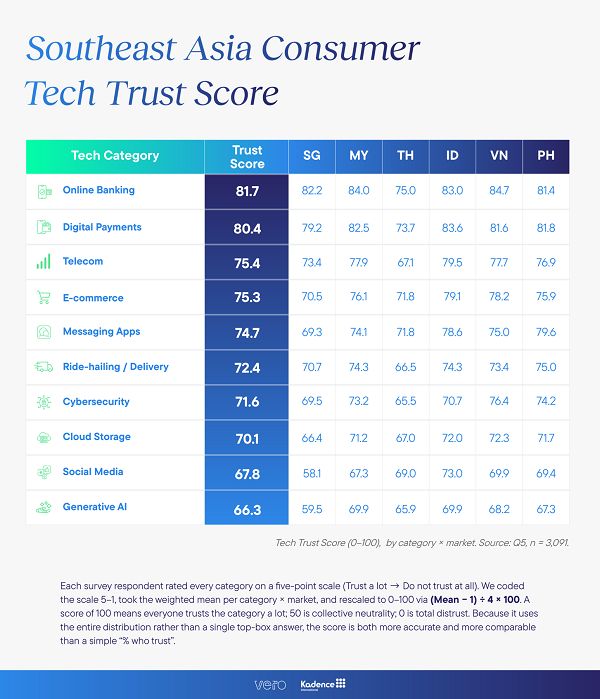
Online banking recorded an average trust score of 81.7, followed by digital payments at 80.4. However, more than half of consumers said they would be quickest to stop using these services following a major scam, data leak, or service failure.
The study suggests that when technology handles money and personal data, consumers expect trust to be protected continuously rather than earned once.
Financial technology leads regional trust
The study covered cloud storage, cybersecurity, e-commerce, digital payments, generative AI, messaging apps, online banking, ride-hailing and delivery, social media, and telecommunications.
Financial technology services emerged as the most trusted categories, supported by clearer regulation and visible security expectations. Telecom, e-commerce, messaging apps, ride-hailing, and cybersecurity formed a broad middle tier, while social media ranked lower despite its widespread use.
Generative AI received the lowest or second-lowest trust score in every market surveyed, indicating that newer technologies still have substantial ground to cover in earning consumer confidence.
“Trust is probably the single most important indicator of success and the key ingredient for sustainable growth in any sector, but more so in technology,” said Konwika Fikaew, vice president for tech communications at Vero.
“This Tech Trust Score comes at a critical time for both tech brands and consumers, when adoption is accelerating at an exciting pace and confidence is tested at a deeper level. This offers a very clear view of where trust is strongest and where it trails, which brands, governments, and consumers can use to make better decisions about how technology is built, regulated, and used.”
Data misuse and scams drive consumer concern
Nearly half of respondents, or 49.5%, ranked personal data misuse as their leading concern. Online scams and fraud were even more widely shared, appearing among the top three concerns of 79% of all respondents.
Consumers showed limited tolerance for serious incidents, with 42% saying they would immediately stop using the affected technology brand or platform. This response was strongest in the Philippines, where 56% said they would quit immediately, followed by Malaysia at 50% and Singapore at 48%.
Consumers in Indonesia and Vietnam were more willing to pause their use and wait for a problem to be resolved. Thailand was the least reactive market, with 30% saying they would stop using a platform immediately, while only 3% of respondents across the region said they would continue as normal.
“One of the patterns we’ve observed in the Philippines is that consumers are becoming more discerning about the technology they choose to engage with,” said Lisa San Buenaventura, PR senior account manager at Vero.
“While adoption remains high, people are paying closer attention to the signals that build confidence: from transparency and accountability to how organizations safeguard the interests of their users. As technology becomes more embedded in everyday life, consumers expect the same level of trustworthiness they would from the institutions and services they rely on daily.”
Consumers demand accountability but trust independent voices
The study also found a gap between who consumers hold responsible and who they trust to explain a failure.
Across the region, 33% of respondents said a company’s CEO or founder should be held most accountable during a major incident. However, company leaders were also the least trusted voices to explain what went wrong.
Independent cybersecurity experts were the most trusted post-incident source in four markets, including Indonesia at 51%and Vietnam at 44%. Singapore was the only market where government was the most trusted source following an incident, at 43%.
The findings suggest that company communication remains necessary, but may not be enough to rebuild confidence without independent validation and visible corrective action.
Regulation, track record, and transparency shape trust
When asked what provides the strongest proof that a technology company can be trusted, respondents identified three main signals: regulatory compliance, a proven track record, and transparency.
Government approval and compliance ranked highest in Singapore at 36%, Malaysia at 28%, and the Philippines at 23%. In Indonesia, 43% of respondents viewed a proven track record as the strongest indicator of trustworthiness.
Consumers in Thailand and Vietnam placed the greatest value on clear, plain-language explanations of how their data is used, selected by 26% of respondents in each market.
“This study reveals how critical government approval and regulatory compliance have become to building trust between consumers and tech brands,” said Pongsiri Poorintanachote, managing partner at Vero Advocacy.
“Regulatory obligations are often seen as an operational burden, but this data suggests they can do more: they make a company’s sense of accountability visible to consumers.”
High usage does not always mean high trust
The study also found that frequent use should not be treated as proof of confidence. Consumers may continue using platforms because they are convenient, habitual, or difficult to replace, even when trust remains weak.
Social media demonstrates this gap most clearly. It is used by 79% of consumers, compared with a regional category average of around 38%, but recorded an average trust score of only 67.8 and ranked lowest or second-lowest across all six markets.
By contrast, telecom, e-commerce, ride-hailing, cybersecurity, and cloud storage recorded trust levels that exceeded their usage rates. Online banking and digital payments stood out for combining above-average usage with the region’s highest trust scores.
“Usage is an important signal, but it is not a complete measure of trust,” said Ashutosh Awasthi, director at Kadence International. “The trust-usage gap reveals a more complex consumer relationship with technology.”
For technology companies, the study points to the need to move beyond adoption and engagement metrics. Sustained trust depends on whether consumers feel protected, informed, and confident that companies and regulators will respond effectively when problems arise.
In Summary
The Southeast Asia Consumer Tech Trust Score finds that online banking and digital payments are the region’s most trusted technology categories, but consumers have little tolerance for serious failures involving money or personal data. The study identifies regulatory compliance, transparency, track record, independent expertise, and visible accountability as major factors in building and restoring consumer trust.