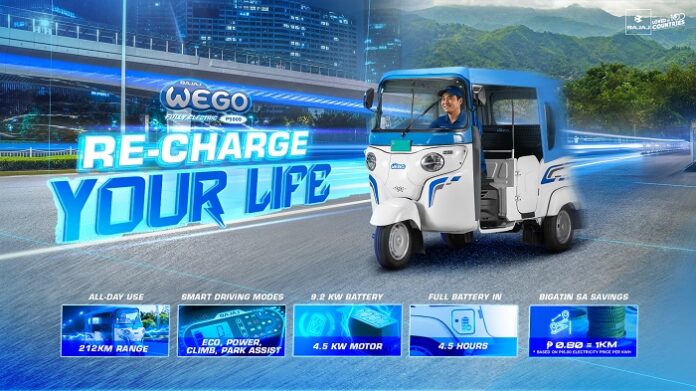

Bajaj’s first fully electric three-wheeler combines up to 212km of range, four driving modes, and a 4.5-hour charging time with an introductory price of PHP329,888.
The BAJAJ WEGO P5009 is Bajaj’s first fully electric three-wheeler, designed for everyday mobility, livelihood use, and commercial operations.
Its key specifications include a claimed range of up to 212 kilometers, four driving modes, a 9.2kWh battery, and a 4.5kW motor. The vehicle is also rated for a full charging time of approximately 4.5 hours.
Four driving modes for different conditions
The WEGO P5009 comes with Eco, Power, Climb, and Park Assist modes.
These settings give drivers flexibility depending on route, load, terrain, and operating conditions. Eco prioritizes efficiency, while Power and Climb are designed for situations that require stronger performance. Park Assist makes low-speed maneuvering easier.
Up to 212km of claimed range
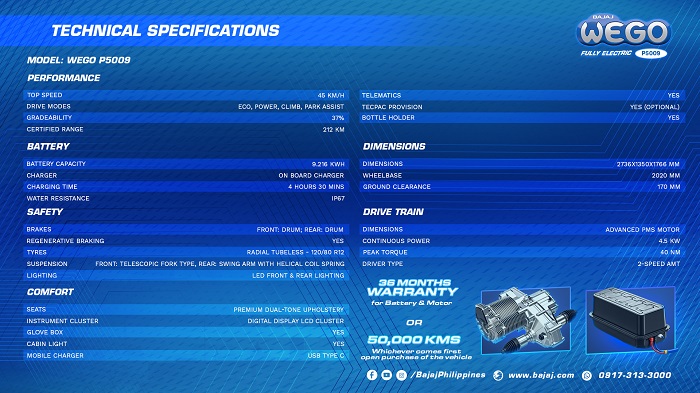
The electric powertrain uses a 9.2kWh battery and 4.5kW motor, with the release citing up to 212km of range on a full charge.
That range suits daily routes and repeated city use, especially for drivers who depend on the vehicle for livelihood or business operations.
Charging cost estimated at about PHP0.80 per kilometer
The supplied material estimates running cost at around PHP0.80 per kilometer, based on a 9.216kWh battery, an electricity rate of PHP15 per kWh, and the cited 212km range.
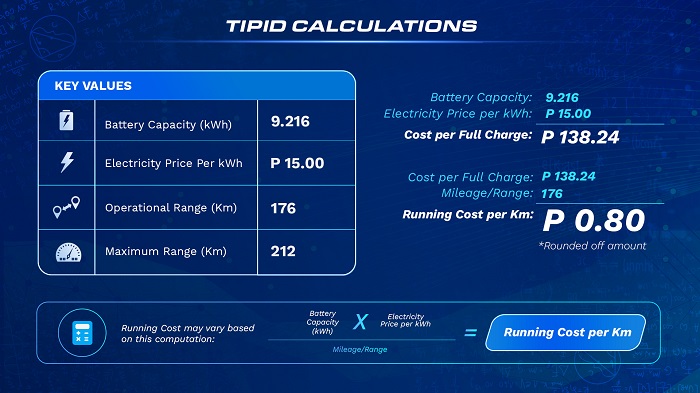
That estimate highlights the potential operating-cost advantage of electric mobility for drivers covering multiple trips each day. Actual cost per kilometer will still depend on electricity rates, charging efficiency, route conditions, load, driving style, and real-world range.
Priced at PHP329,888
The BAJAJ WEGO P5009 is offered at an introductory price of PHP329,888.
The vehicle, battery, and motor are covered by a 36-month or 50,000km warranty, whichever comes first. Customers can inquire about or purchase the WEGO P5009 through 38 BAJAJ 3S Shops nationwide.
Built for different mobility needs
The campaign positions the WEGO P5009 for several types of users, including daily earners, business operators, and local government units.

For livelihood users, the emphasis is on lower operating cost per kilometer. For business owners, the focus is on efficiency and operational flexibility, while LGU use centers on transport modernization and more sustainable local mobility.
The recurring theme is practical electric mobility that can support income-generating, commercial, and community applications without moving away from the three-wheeler format familiar to many operators.