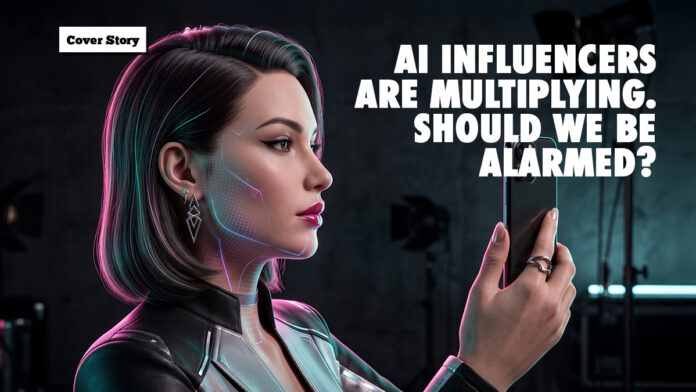

Influencers are everywhere, and AI is in everything. We see influencers telling us what to wear, what to eat, what to buy, and where to go. At the same time, AI is creeping into almost everything we do online. So what happens when the two finally meet?
Apparently, we get AI influencers.
We already have millions of real people competing for our attention, yet the internet has decided it also needs personalities that do not even exist. These digital personalities are not just collecting followers, either. Some promote products, work with brands, and build businesses.
WHY ARE WE HUMANS DOING THIS?
Creating an AI persona can be like designing another version of yourself, or an entirely different person. You can choose the face, clothes, personality, aesthetic, and even the way that character communicates. For creators, it offers another form of identity experimentation without necessarily exposing as much of their offline lives.
There is also the question of control. A creator can decide how much of their real identity they want to reveal, including details such as their age, gender, appearance, or personal life. For people who have experienced harassment or discrimination online, keeping some distance between their real identity and their digital persona may be appealing.
Then there is predictability. Human creators have moods, schedules, bad days, and lives off-screen. A digital personality can be designed to appear consistent and available around the clock.
Companies can see the appeal too. An AI influencer does not need to travel to a photoshoot, coordinate schedules, or physically appear at an event. A digital character can be reused across campaigns and adapted for different markets or formats. That does not mean creating and maintaining one costs nothing, but it can give brands and creators greater control over how a character appears and behaves.
So the attraction is understandable. AI influencers sit at the intersection of identity, creative freedom, constant connection, and business. For some creators, they are another way to express themselves. For companies, they can become another way to reach an audience.
SINCE WHEN IS THIS HAPPENING?
Digital characters did not suddenly appear with the current AI boom. Virtual personalities have been around for years. What has changed is how easy it has become to create realistic-looking faces, voices, images, and videos.
Lil Miquela, for example, has been presented as a virtual influencer for years, while Spain’s Aitana López is another widely discussed digital personality. The Philippines has also seen locally created virtual personalities such as Lina Lately. These characters show that an influencer doesn’t necessarily have to be a real person to attract attention online.
But there is an important difference between a fictional digital personality that is presented as fictional and AI-generated content that impersonates an actual person. One creates a new identity. The other borrows somebody else’s.
That difference becomes important when we start talking about cybersecurity.
WHY DO PEOPLE EVEN FOLLOW THEM?
Maybe because humans have always been perfectly capable of becoming emotionally attached to fictional characters. We follow stories, obsess over fictional relationships, and sometimes care far too much about people who were never real in the first place. An AI influencer simply brings that relationship into a space where fictional characters can now talk back, post regularly, and interact with followers.
There is also the curiosity factor. Some AI influencers look realistic enough to make people stop scrolling just to figure out whether they are looking at a real person. Others deliberately lean into their artificial nature.
Then there is the uncanny valley. The closer something gets to looking human without quite getting there, the more unsettling it can become. A face may look almost perfect, but something about the eyes, expressions, or movement still feels slightly wrong.
Strangely, that artificiality does not necessarily stop people from following. In some cases, knowing that the character is fictional is part of the appeal. Followers are not always being fooled. Sometimes, they are willingly participating in the fiction.
That raises an interesting question about authenticity online. If people knowingly follow a fictional personality, does it matter that the person is not real? Maybe authenticity online was never entirely about being real. Maybe it also depends on whether people understand what they are interacting with.
WHEN AN INFLUENCER BECOMES A SECURITY RISK
This is where things get more complicated.
Cybersecurity is not only about protecting passwords and devices. It also involves knowing who or what we can trust online. If a familiar influencer recommends an investment, announces a giveaway, promotes a product, or sends followers to a website, people may act because they already trust that person’s face and voice.
But what if the person in the video never actually said any of it?
In 2025, videos circulated online that appeared to show businessman Ramon Ang promoting investment opportunities. Fact-checkers found signs that AI had been used to manipulate his face and voice. Similar deepfake content has used the likenesses of other prominent Filipinos, including President Ferdinand Marcos Jr., to direct viewers toward investment offers or suspicious links.
This is very different from following a disclosed virtual influencer. The danger comes from using AI to make a real person’s identity appear to endorse something they never endorsed.
Scammers can effectively borrow trust by copying someone’s face or voice. A scammer doesn’t necessarily need to hack a person’s social media account if they can create convincing content that makes it seem as though the person is speaking directly to an audience.
This doesn’t apply only to celebrities. Business owners, executives, government officials, family members, and ordinary people can also be impersonated. As more of our faces, voices, photographs, and videos become part of our digital footprint, those pieces of our identities can potentially be used in ways we never intended.
WHO IS RESPONSIBLE?
The law is still catching up with what AI can do.
In the Philippines, there is no single law that covers every issue involving AI-generated people or deepfake content. Depending on how the technology is used, questions involving privacy, consumer protection, intellectual property, fraud, and cybercrime may come into play.
The National Privacy Commission has also raised concerns about how personal information is used in AI systems. A person’s face, voice, images, and other identifying information can involve privacy and data-protection issues, particularly when they are collected or processed without proper authority.
But accountability can become difficult when content moves quickly across platforms, and the person who created it may be hard to identify. Who is responsible when a fake identity causes real-world harm: the person who created it, the platform that distributed it, the company that used it, or some combination of them?
Those questions become more difficult as synthetic content becomes easier to produce.
WHAT CAN WE ACTUALLY DO ABOUT IT?
AI-generated content is not going away, and not every virtual personality is trying to deceive us. A fictional digital character that openly presents itself as synthetic is fundamentally different from someone secretly using AI to impersonate a real person.
The bigger problem is deception.
That means platforms, brands, creators, and regulators all have a role to play. Clear disclosure can help audiences understand when a personality or piece of content is artificially generated. Better identity verification and reporting systems can make impersonation more difficult to spread, while detection tools may help platforms identify manipulated content.
For the rest of us, digital literacy increasingly includes knowing when an identity deserves a second look. A familiar face, recognizable voice, or polished video is no longer enough on its own to prove that the person really said what we are seeing or hearing.
The goal is not to distrust everyone we meet online. It is to understand the difference between an identity that is deliberately fictional and one that is deliberately pretending to be real.
Words by Aljhelyn Piador
Also published in GADGETS MAGAZINE Volume 27 Issue No. 3